

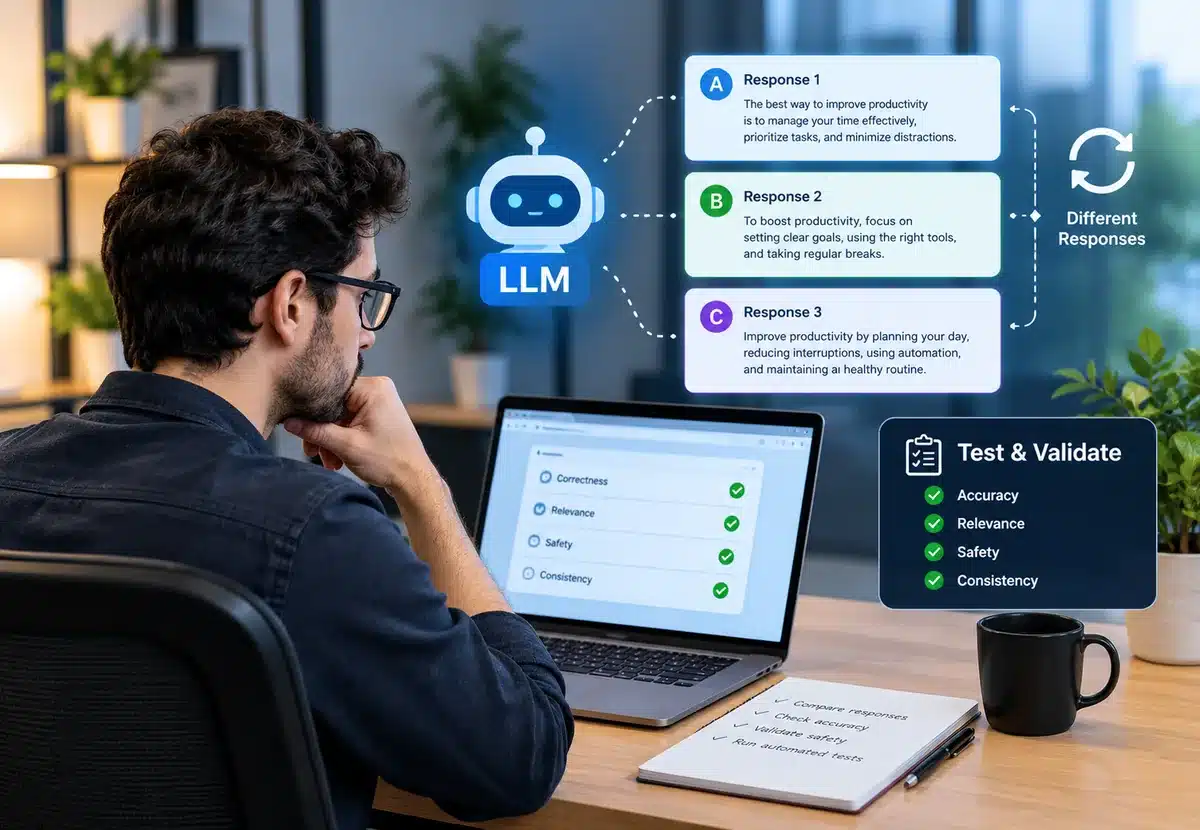
Large language models (LLMs) are changing how applications interact with users. From customer support chatbots to document summarization and intelligent search, AI-powered features can generate responses that adapt to different questions and contexts.
However, this flexibility creates a challenge for software testing. Unlike traditional applications, LLM-powered systems do not always produce identical outputs for identical inputs.
A chatbot might answer the same customer question using different sentences. A document summarization tool might highlight different details. Both responses could be correct, even though their wording differs significantly.
So how can developers test AI responses when the wording keeps changing?
The solution is to combine deterministic checks with semantic validation. Instead of requiring identical text, QA teams can verify whether responses communicate the correct meaning, contain essential information, follow business rules, and avoid prohibited content.
This approach makes LLM application testing more practical without sacrificing reliability.
Why Do LLM Responses Change Between Test Runs?
Traditional software generally follows predictable logic. Given identical inputs and the same application state, a conventional function should produce the same result.
Large language models behave differently because they generate text by predicting tokens based on learned patterns, input context, and generation settings.
Several factors can influence their responses.
1. Probabilistic Text Generation
LLMs assign probabilities to possible next tokens. When sampling is enabled, different tokens may be selected during separate executions.
For example, a chatbot answering a question about delivery times might respond:
Response A: “Your order should arrive within three business days.”
Response B: “You can expect delivery in approximately three working days.”
These responses communicate essentially the same information, but an exact-text comparison would identify them as different.
2. Temperature and Model Configuration
Temperature and other decoding parameters influence how responses are generated.
Lower temperatures generally produce more consistent outputs, while higher temperatures encourage variation.
However, setting temperature to zero does not guarantee identical responses across every execution or infrastructure configuration.
3. Context and Model Changes
LLM responses can also change because of updated system prompts, conversation history, retrieved documents, model versions, or application configurations.
Even small changes in contextual information can affect generated answers.
Consequently, testing nondeterministic AI requires evaluating response quality rather than expecting identical text every time.
Why Exact-Match Assertions Are Not Enough for LLM Testing
Traditional test automation frequently relies on assertions that compare actual results against predefined expected values.
For example, a conventional application might display:
“Payment completed successfully.”
A test can confirm that this exact message appears.
However, an AI assistant could communicate the same successful outcome in several ways:
- “Your payment has been processed successfully.”
- “The transaction is complete.”
- “We’ve received your payment.”
An exact-match assertion expecting the first sentence would fail on the other two, even if all three accurately describe the completed payment.
This creates false failures and unnecessary test maintenance.
Exact-Match Assertions vs. Semantic Assertions
Consider an AI customer support assistant answering:
User question: “Can I return an item after 15 days?”
The company’s actual policy allows returns within 30 days of delivery.
| Validation method | What the test checks | Result |
| Exact match | Response equals “Returns are allowed within 30 days of delivery.” | Fails when wording changes |
| Keyword check | Response contains “30 days” | May pass an incorrect answer |
| Semantic assertion | Response correctly communicates that returns are allowed within 30 days of delivery | Passes equivalent, correct responses |
A keyword check could mistakenly accept:
“Returns are not allowed within 30 days.”
Although the response contains the expected phrase, its meaning contradicts the actual policy.
Semantic testing helps address this limitation by evaluating the meaning of generated content.
However, semantic equivalence alone is insufficient when an answer must also satisfy specific factual or business requirements.
Four Levels of AI Response Validation
Effective LLM testing requires distinguishing between different aspects of correctness.
1. Exact Wording
Exact-text validation confirms whether a response matches a specific string.
This remains appropriate for fixed disclaimers, required legal notices, exact identifiers, and other content where wording must not change.
2. Factual Correctness
Factual validation determines whether the response contains accurate information.
For example, an AI assistant explaining a refund policy must provide the correct deadline, eligibility conditions, and applicable exceptions.
A response might sound reasonable while containing incorrect facts. Semantic similarity to an expected answer cannot independently establish factual accuracy.
3. Semantic Equivalence
Semantic validation examines whether two responses communicate the same essential meaning.
For example:
Expected: “Customers must cancel their subscriptions before the next billing cycle to avoid additional charges.”
Actual: “To prevent another charge, cancel your subscription before your upcoming billing date.”
The wording differs, but the core instruction remains equivalent.
4. Business Expectations
A response can be grammatically correct, factually accurate, and semantically appropriate while still violating business requirements.
For example, a banking assistant might explain a financial product correctly but reveal information that the current user is not authorized to access.
Business validation should therefore include authorization, privacy, safety, formatting, and workflow requirements.
These four validation levels serve different purposes and should complement one another.
Practical Approaches to Automated LLM Testing
A reliable generative AI quality assurance strategy uses multiple testing methods rather than depending on a single assertion type.
Semantic Validation
Semantic validation checks whether generated responses satisfy intended meanings or requirements.
QA teams can define natural-language expectations such as:
- The response must explain that returns are accepted within 30 days of delivery.
- The chatbot must not promise refunds for ineligible purchases.
- The summary must mention the contract’s expiration date.
- The answer must acknowledge when requested information is unavailable.
These criteria focus on essential information rather than sentence structure.
Structured Output Validation
Some LLM applications generate structured responses such as JSON.
For example:
{
“order_status”: “shipped”,
“estimated_delivery_days”: 3,
“refund_eligible”: false
}
QA teams can validate the JSON schema, required fields, data types, permitted values, and relationships between fields.
They should also verify business logic, such as whether refund_eligible matches the actual order policy.
Structured output makes certain validations deterministic, although valid JSON does not guarantee correct information.
Reference-Based Evaluation
Reference-based evaluation compares generated answers against trusted source material.
For example, a document summarization application can be tested against known facts extracted from a verified source document.
Instead of requiring a specific summary, tests can check whether the generated text includes required facts and avoids unsupported statements.
This approach is especially useful for retrieval-augmented generation (RAG) systems.
Human Review
Automated evaluation cannot reliably resolve every ambiguity.
Human reviewers remain important for assessing complex reasoning, domain-specific accuracy, tone, and situations where several interpretations may be acceptable.
A practical approach is to automate straightforward checks and escalate uncertain, high-risk, or disputed results for human review.
Using AI-Assisted Validation for Changing Responses
AI-assisted validation offers an alternative to maintaining numerous exact-text assertions.
For example, testRigor supports AI-based natural-language assertions that evaluate whether content displayed in an application satisfies a specified condition.
Instead of checking whether a chatbot produces an exact sentence, QA engineers can describe the expected meaning.
An illustrative testRigor validation might look like this:
Check that the page “explains that customers can return eligible products within 30 days of delivery” using AI
This allows the test to assess the response’s meaning rather than requiring identical wording.
For teams testing LLM-based applications, understanding how generative models interpret language and why their outputs vary can also help establish more realistic validation criteria.
AI-assisted assertions are particularly useful when responses are flexible but must satisfy clearly defined conditions.
Nevertheless, critical facts such as monetary amounts, deadlines, account identifiers, and permissions should also be checked against authoritative data.
Real-World Examples of LLM Application Testing
Example 1: AI Customer Support
Imagine an online retailer using an AI chatbot to answer questions about refunds.
A customer asks:
“Can I get my money back if I return a damaged product?”
The expected behavior is to explain the company’s refund policy, identify applicable conditions, and provide an appropriate next step.
A practical automated test should verify that:
- The response correctly explains eligibility for damaged products.
- The chatbot does not invent refund conditions.
- Any stated deadline matches the company’s policy.
- The answer provides an appropriate next step.
The exact wording can change, provided the response satisfies these requirements.
Example 2: AI Document Summarization
Consider an application summarizing business contracts.
The original contract states:
- The agreement expires on December 31.
- Renewal requires written approval.
- Either party may terminate with 60 days’ notice.
A generated summary should accurately preserve these facts.
One response might describe the termination requirement as “two months’ notice.” However, that is not always equivalent to 60 days, so a strict business validation should reject the substitution when precision matters.
This illustrates why semantic testing must be combined with exact factual checks.
Example 3: AI Information Retrieval
Imagine an internal knowledge assistant answering employee questions using company documentation.
An employee asks:
“What is the maximum reimbursement for business travel?”
The official policy states that eligible hotel expenses are reimbursed up to $250 per night.
The test should confirm that the assistant retrieves the relevant policy, states the correct limit, preserves eligibility conditions, and avoids inventing additional benefits.
For RAG applications, QA teams should also test whether retrieved documents actually support the generated answer.
A response that sounds convincing but lacks supporting evidence should not automatically pass.
How to Define Reliable Acceptance Criteria
The biggest improvement QA teams can make is replacing vague expectations with measurable acceptance criteria.
Instead of requiring that an AI response be “helpful and accurate,” define specific conditions.
For example, a customer support chatbot’s acceptance criteria might be:
| Requirement | Validation approach |
| Correct refund deadline | Compare with policy data |
| Explanation of return eligibility | Semantic validation |
| No unsupported refund promises | Business-rule and semantic checks |
| Valid response format | Schema validation |
| No disclosure of another user’s data | Authorization and privacy tests |
Each requirement should have an explicit pass/fail rule, a trusted reference where applicable, and an escalation path for ambiguous cases.
Teams should also create test datasets containing expected successes, expected failures, borderline examples, and adversarial prompts.
This helps determine whether evaluators can distinguish genuine defects from acceptable variation.
Can Another LLM Reliably Evaluate AI Responses?
Using one language model to evaluate another is often called LLM-as-a-judge.
This technique can support automated evaluation at scale, but it introduces additional uncertainty.
An AI evaluator may misunderstand the expected behavior, overlook subtle factual errors, favor longer answers, or produce inconsistent judgments.
Research published in NeurIPS, Judging LLM-as-a-Judge with MT-Bench and Chatbot Arena, discusses limitations including position, verbosity, and self-enhancement biases.
To reduce these risks, QA teams should calibrate AI evaluators against human-labeled examples, use clearly defined evaluation rubrics, and investigate disagreements.
An AI-generated passing result should never be treated as definitive proof of correctness.
Building a Reliable LLM Testing Strategy
A practical strategy for production LLM applications involves six steps:
- Identify critical workflows. Prioritize high-impact chatbot interactions, document processing tasks, and retrieval operations.
- Separate deterministic and nondeterministic requirements. Use exact assertions for fixed values, schemas, permissions, and required wording.
- Define semantic acceptance criteria. Specify the meaning, essential facts, and business conditions every response must satisfy.
- Build representative test datasets. Include paraphrased prompts, edge cases, incorrect answers, and adversarial scenarios.
- Run repeated evaluations. Test multiple outputs under controlled configurations and track failure rates, evaluator disagreements, and factual errors.
- Monitor production behavior. Review failures, maintain evaluation datasets, and retest after model, prompt, or retrieval changes.
Organizations should also consider broader AI risk management practices.
The NIST Generative AI Profile provides guidance for identifying and managing risks associated with generative AI systems throughout their lifecycle.
Importantly, testing should include both application behavior and model-generated content. A technically successful API request does not necessarily mean that the answer is useful, accurate, or safe.
Conclusion
LLM application testing requires a different approach from traditional software validation because generated responses can change without becoming incorrect.
Exact-text assertions remain valuable for deterministic requirements, but they are insufficient for evaluating flexible, natural-language content.
By combining semantic validation, structured output checks, trusted reference data, and human review, QA teams can verify that AI responses satisfy business expectations without requiring identical wording.
The objective is not to eliminate variation from generative AI. It is to ensure that acceptable variation does not compromise factual accuracy, application behavior, or user trust.
For teams building production LLM applications, clearly defined acceptance criteria and layered automated testing provide a practical foundation for more reliable AI-powered software. To learn more about artificial intelligence, its capabilities, and emerging developments, NeuroBits AI is a great resource for exploring AI technologies and trends.
