

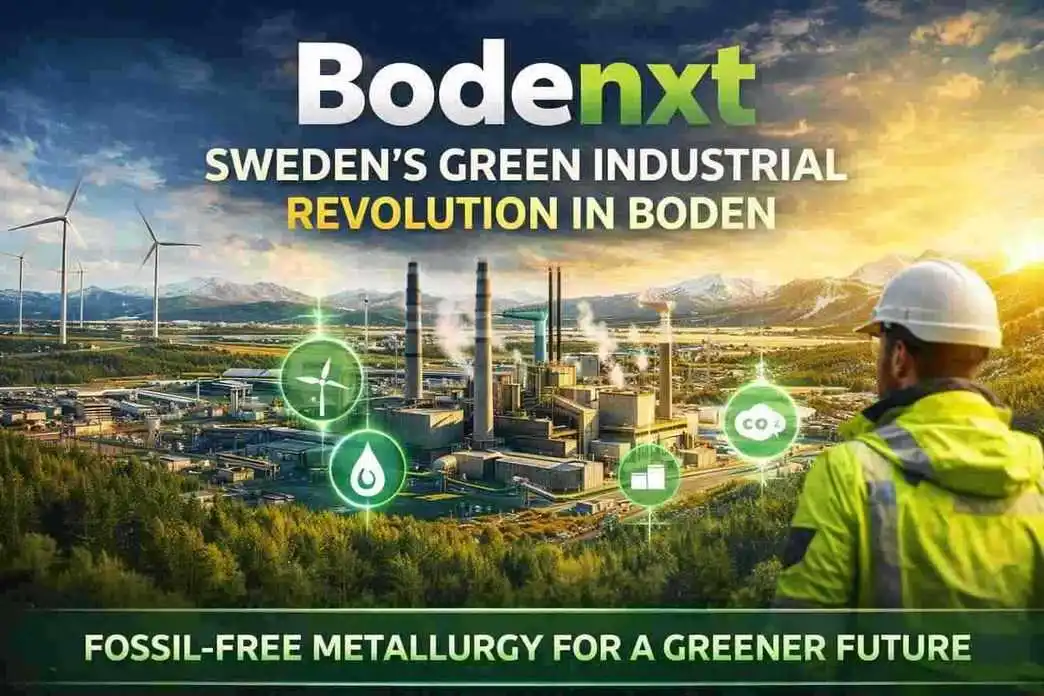
Steel production causes nearly 7–8% of global CO₂ emissions. Bodenxt is Sweden’s bold answer to that problem — and it starts in one small northern municipality. Launched by the municipality of Boden in northern Sweden, Bodenxt is a multi-decade acceleration strategy compressing nearly 20 years of industrial, social, and infrastructure growth into a single generation. It is not a factory, not a branding campaign, and not a short-term stimulus plan.
It is a synchronized framework aligning heavy industry, renewable energy, workforce expansion, housing development, digital infrastructure, and community planning into one coordinated blueprint. The arrival of Stegra’s green steel plant — formerly H2 Green Steel — triggered this transformation, pushing Boden to the forefront of Europe’s fossil-free industrial revolution. But Bodenxt goes far beyond steel. It is a living model of how climate-neutral growth, social transformation, and economic resilience can move together — proving that industry grows only when society grows with it.
What Is Bodenxt? The Initiative Explained
Bodenxt is not a single project. It is a synchronized framework launched in Boden, Sweden, that aligns heavy industry, renewable energy, workforce expansion, housing development, and digital infrastructure under one municipal strategy.
The core objective is to transform Boden into a globally competitive green industrial hub while building a livable, resilient city at the same time. It is a community development initiative — and a holistic development initiative — built on inclusive societal development where social, economic, and environmental goals are treated as inseparable.
Key characteristics of the initiative:
- Scope: Industrial, social, economic, and digital transformation
- Timeline: 20-year development compressed into a few years
- Model: Proactive municipal coordination driven by green transition goals
- Blueprint: Sustainable development that benefits both current and future residents
- Vision: Social transformation aligned with industrial expansion
The Industrial Catalyst: Green Steel and Hydrogen at Scale
The anchor of Bodenxt is the Stegra green steel plant — formerly known as H2 Green Steel — located within the Boden Industrial Park. This facility represents a structural break from traditional blast-furnace steelmaking by replacing coal with green hydrogen and renewable electricity.
Steel production currently accounts for roughly 7–8% of global CO₂ emissions. This plant directly targets that problem at an industrial scale, making climate-neutral steel production a reality rather than a concept. It positions Boden at the center of Europe’s green economy and drives the broader steel industry toward genuine decarbonization.
| Metric | Data Point |
| Industrial Land Area | ~550 hectares |
| Annual Steel Production Target | ~5 million tonnes |
| CO₂ Emissions Reduction | Up to 95% vs. conventional steel |
| Projected Direct Jobs | ~2,000 by 2030 |
| Energy Model | Green hydrogen + renewable electricity |
The implications extend far beyond metallurgy. Thousands of jobs are being created, supply chains are expanding, and international attention is focused on Boden as a benchmark for industrial decarbonization driven by major industrial investments.
Boden Industrial Park: Infrastructure Designed for Scale
The Boden Industrial Park spans approximately 550 hectares — larger than many urban districts in Scandinavian capitals — and is recognized as one of Europe’s largest green industrial zones. Its scale supports integrated logistics, hydrogen production, energy distribution, and direct rail access without fragmented planning.
The railway connection to the park was completed ahead of schedule and under budget, strengthening export competitiveness and long-term industrial viability within the broader European infrastructure landscape.
Critically, above-ground and below-ground infrastructure were planned simultaneously. Fiber networks, transport corridors, utilities, and subsurface systems were engineered together — not retrofitted later. This infrastructure integration reduces long-term costs and systemic risk across the entire delivery model.
Compressed Urban Development: A New Growth Model
Traditional urban planning unfolds over decades. Bodenxt rejects that pace entirely.
The initiative acknowledges that climate goals, technological innovations, and industrial transitions move too fast for slow, incremental adaptation. By condensing 20 years of development into just a few, Bodenxt embraces agile planning to stay ahead of demographic change and the global climate crisis.
The result is a compressed timeline where housing, transportation, education, healthcare, culture, and governance must all develop simultaneously — creating both prosperity and stability for a rapidly growing municipality.
This creates real pressure:
- Schools must open as new neighborhoods are built
- Public transport must scale with population growth
- Social integration must happen alongside physical construction
- Community cohesion and cultural identity must be protected as the municipality rapidly evolves
- A livable environment must be maintained even as industrial growth surges
The alternative — uncoordinated growth — risks boom-and-bust cycles, urban sprawl, housing shortages, and labor gaps. Bodenxt exists specifically to prevent those outcomes.
Sustainability at the Core of Bodenxt
Sustainability in Bodenxt is not a policy checkbox. It is the foundation of every urban planning decision — covering environmental, social, and economic dimensions simultaneously. Sweden’s northern regions offer a unique context where renewable energy abundance, equality of access, public health priorities, and future generations’ needs all shape how Bodenxt plans and builds. The initiative reflects a commitment that growth today must not compromise the needs of those who come after.
Environmental Sustainability
Bodenxt prioritizes carbon emission reduction, renewable energy adoption, and climate-resilient infrastructure. The green steel plant leads this effort across Europe, but environmental goals extend to energy-efficient buildings, optimized transportation networks, wind and solar power integration, and phasing out dependency on fossil fuels. Sustainable links between urban and rural areas ensure the entire region — not just the industrial core — stays aligned with Sweden’s national climate goals.
Social Sustainability
Rapid population growth can fracture communities if social cohesion is ignored. Bodenxt directly addresses this by designing housing developments for varied income levels with affordable options for all lifestyles, creating public spaces that encourage cultural exchange, and ensuring access to education, healthcare, and public services for both long-term residents and newcomers.
Cultural integration is treated as a priority, not an afterthought. Inclusivity is non-negotiable — the initiative integrates people from across Sweden and beyond while protecting the social fabric and labor market participation that already exists in Boden.
Economic Sustainability
Bodenxt targets long-term prosperity, not short-term gains. By supporting small and medium-sized businesses alongside large industrial projects, and by encouraging innovation and entrepreneurship across the local economy, the initiative builds a resilient, diversified economy capable of withstanding global fluctuations — without the volatility of boom-and-bust cycles that have historically plagued industrial towns.
Five Structural Pillars of Bodenxt
Bodenxt operates through five coordinated pillars, each functioning independently but aligned under one strategic framework:
- Skills Supply — Partnerships with vocational institutes and universities to build labor pipelines in hydrogen technology, green metallurgy, logistics, and advanced manufacturing
- Living & Housing — Accelerated housing construction and zoning reforms to keep the supply pace with job creation
- Business Development — Integration of small and mid-sized enterprises into the industrial cluster as suppliers, service providers, and tech startups
- Infrastructure Above Ground — Expansion of transport networks, grid capacity, and digital connectivity in lockstep with industrial timelines
- Infrastructure Below Ground — Subsurface planning for utilities and pipelines to support future expansion without costly reconstruction
Population Growth and Community Transformation
Boden was once forecast to face demographic decline. Those forecasts of stagnation have reversed sharply.
Hundreds of new residents — engineers, construction workers, international specialists, logistics professionals, and entrepreneurs — have already relocated to Boden due to industrial expansion. Schools, educational partnerships, retail, and service sectors are all expanding in response, strengthening the local tax base.
The social challenge is equally significant. Income levels vary across the incoming workforce, and public spaces must serve diverse communities. Cultural exchange and social transformation must happen alongside physical construction. Bodenxt prioritizes:
- Participation and dialogue — residents, businesses, and civil society co-create solutions
- Lifelong learning — ensuring both existing residents and newcomers have access to the evolving labor market
- Community cohesion — preserving social fabric while welcoming new arrivals
- Housing development — designed to support diverse lifestyles across income levels
A growing tax base also means greater long-term investment capacity for public services — a lesson relevant to European municipalities facing similar pressures.
Energy Advantage: The Renewable Backbone
Sweden’s northern grid provides access to large volumes of fossil-free electricity — primarily hydro and wind. For hydrogen-based steel production, stable renewable electricity is not optional. It is foundational.
Boden’s geographic position reduces grid congestion risk and offers significant scalability potential. Cold climate conditions also improve industrial energy efficiency by lowering cooling loads in heavy processes and data systems.
This energy advantage is the economic catalyst that makes the entire Bodenxt model viable at scale.
Digitalization and Smart Urban Solutions
Digital infrastructure enables Bodenxt’s rapid pace of change. Smart urban planning tools, data-driven decision-making, and digital public services allow the municipality to respond quickly to shifting needs across both urban and rural areas.
Practical applications include:
- Transportation optimization — data-driven systems reduce traffic flows, lower carbon emissions, and support electric vehicles
- Smart grid technology — ensures efficient energy use across the municipality
- 5G industrial networks and edge computing — support real-time industrial monitoring
- Digital public services — improve resident access to information and municipal resources
Early investment in digital infrastructure also strengthens Boden’s appeal to global talent and innovative companies aligned with the green transition.
Economic Multiplier Effects Beyond Steel
Bodenxt’s economic impact extends well beyond metallurgy. Secondary and tertiary economic layers are forming around the industrial core:
- Hydrogen innovation and storage solutions
- Logistics optimization platforms
- Digital industrial monitoring systems
- Smart agriculture pilots using AI-assisted greenhouse models
- Edge computing and 5G industrial networks
These adjacent ecosystems diversify economic risk across the secondary and tertiary economy. If green steel drives phase one, digitalization and energy innovation secure phase two — creating a layered economic base that reduces dependence on any single industry.
Bodenxt in a Regional and Global Context
Bodenxt is embedded in the broader green transition across the Norrbotten region and northern Sweden. It creates synergies with neighboring initiatives in infrastructure, skills development, and innovation ecosystems — strengthening workforce pipelines, community growth, and industrial policy alignment across the region.
Globally, Bodenxt positions Boden within an expanding conversation about industrial decarbonization. International interest in fossil-free steel, renewable energy, and sustainable cities means the initiative serves as a real-world model for how local communities can respond to global challenges through climate action and municipal planning. It is a replicable template that Europe and North America are watching closely as a benchmark for scalable solutions.
Bodenxt by the Numbers: Impact Snapshot
The scale of Bodenxt is best understood through data. This is not a demonstration scale — it is a full industrial scale.
| Metric Category | BodenXT Data Point | Strategic Significance |
| Industrial Land Area | ~550 hectares | One of Europe’s largest green industrial zones |
| Steel Production Target | ~5 million tonnes annually | Industrial-scale decarbonization |
| Emissions Reduction | Up to 95% vs. conventional steel | Major carbon reduction per production unit |
| Direct Jobs (Projected) | ~2,000 by 2030 | Long-term labor market transformation |
| Energy Model | Renewable electricity + green hydrogen | Structural break from coal-based metallurgy |
| Infrastructure | Rail, grid, and digital are aligned simultaneously | Reduced systemic bottlenecks |
When industrial land size, hydrogen integration, carbon reduction, and workforce expansion converge in one coordinated plan, the result is not incremental progress — it is structural re-engineering at an industrial scale, positioning Boden as one of Europe’s largest green industrial zones.
Risks and Challenges Facing Bodenxt
No transformation at this scale is without risk. Bodenxt faces measurable structural challenges:
- Energy price volatility across European markets
- Global steel demand cycles that affect long-term production viability
- Hydrogen infrastructure maturity timelines are still developing across the continent
- Workforce relocation barriers are limiting the labor pipeline
- Supply chain disruption from global economic instability
The initiative also faces pressure on housing markets and local governance capacity. Strategic planning, continuous evaluation, and cross-sector partnerships are central to maintaining a resilient municipality. Technological change, economic change, and environmental change all require governance systems that adapt quickly — without losing coordination across pillars.
Early infrastructure investment and policy alignment reduce systemic fragility. By planning housing, energy, transport, and workforce simultaneously, Bodenxt lowers the probability of bottleneck failure.
The Long View: 2030 and Beyond
By 2030, the green steel facility targets full production capacity. By then, Boden’s population structure, housing stock, and infrastructure profile will look dramatically different from pre-transition years.
The real test is durability. Can the ecosystem remain competitive during economic downturns? Can supply chains localize enough to sustain long-term growth?
Bodenxt’s integrated design is its greatest strength. It does not depend on one facility. It builds a layered economic base — measuring success not only in economic output but in quality of life, social cohesion, environmental performance, and the durability of its competitive ecosystem.
Why Bodenxt Matters: Global Significance
Bodenxt demonstrates a replicable model for industrial decarbonization rooted in visionary planning, collective action, and long-term thinking. For municipalities facing climate urgency, it offers a clear path forward.
Boden itself has moved from demographic stagnation to the center of Europe’s green re-industrialization wave. Heavy industry is decarbonizing. Infrastructure is expanding. The population is rising. Energy systems are modernizing. This is what municipal transformation looks like in the 21st century.
The initiative proves that climate change and economic expansion need not conflict — when guided by long-term thinking and inclusive industrial policy:
- Anchor transformation around renewable energy
- Align municipal planning with industrial timelines
- Build infrastructure before capacity strain appears
- Secure workforce pipelines early
- Integrate community growth with industrial policy
If execution remains disciplined, Boden becomes a global industrial hub and a benchmark — proving that climate transition and economic expansion can move in the same direction, at the same time, with scalable solutions others can follow.
Conclusion
Bodenxt is a structural change in motion. A municipality once facing demographic stagnation now leads Europe’s green re-industrialization. Heavy industry is decarbonizing. Infrastructure is expanding. The population is rising. Energy systems are modernizing across decades of compressed development.
The initiative demonstrates that green industrial growth, social cohesion, and economic resilience can move together — when industrial transformation is guided by a clear urban development model built on sustainability, inclusion, and innovation. This is municipal transformation for the 21st century, shaped by climate urgency, social well-being, and disciplined execution.
For cities navigating climate change pressure, Bodenxt offers an industrial hub model grounded in visionary planning, collective action, and long-term thinking. It is not just a local story — it is a scalable blueprint for how communities worldwide can lead the green transition rather than react to it.
FAQs
What is Bodenxt in simple terms?
Bodenxt is a community development initiative guiding the rapid green transition and social transformation of Boden municipality in Sweden.
Why is Bodenxt happening now?
Large-scale green industrial investments — particularly in fossil-free steel production — require fast, coordinated development of housing, infrastructure, and social services.
How does Bodenxt support sustainability?
It integrates environmental, social, and economic sustainability into all planning decisions, targeting low emissions, social inclusion, and long-term resilience.
Who benefits from Bodenxt?
Both existing residents and newcomers benefit through improved infrastructure, job opportunities, public services, and overall quality of life.
Is Bodenxt only about industry?
No. It equally covers social transformation, education, culture, digitalization, and community well-being — making it a holistic development initiative.
Can Bodenxt be a model for other cities?
Yes. It offers a scalable model for municipalities facing rapid growth driven by the green transition, balancing speed with sustainability and social cohesion.
How large is the Boden Industrial Park?
Approximately 550 hectares — one of Sweden’s largest green industrial development zones.
How much steel will be produced annually?
Projected capacity is around 5 million tonnes per year at full scale.
How much CO₂ reduction is expected?
Up to 95% reduction compared to traditional coal-based steelmaking processes.
How many jobs will Bodenxt create?
Roughly 2,000 direct industrial jobs by 2030, with additional indirect employment across housing, logistics, retail, and services.
Why is Boden strategically important?
Its access to renewable electricity, available land, infrastructure readiness, cold climate advantages, and coordinated municipal planning create a strong competitive advantage in green heavy industry.
