

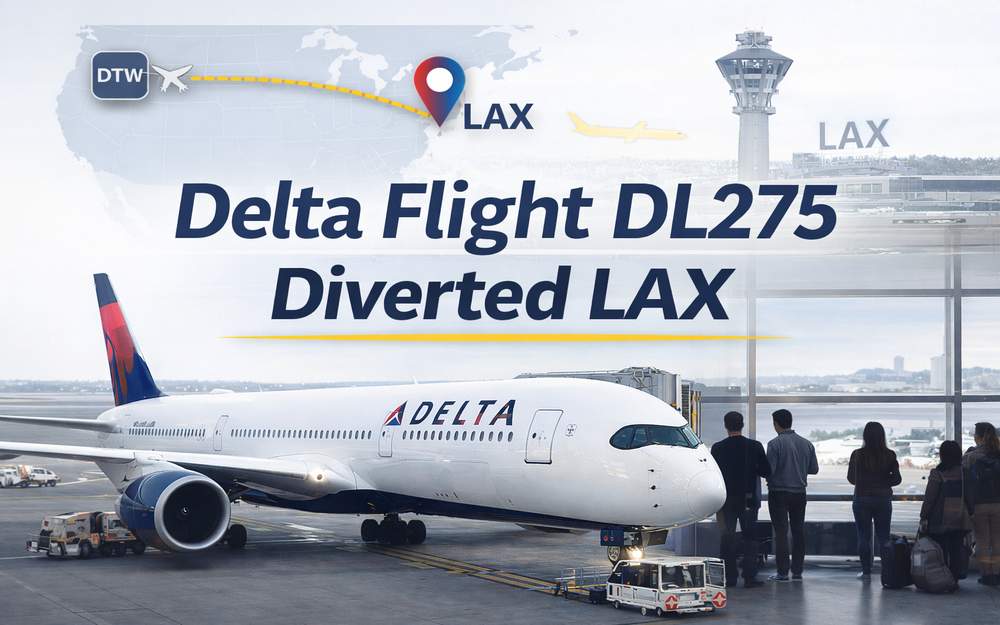
Delta Flight DL275 Diverted LAX on May 27, 2025 — and every year, thousands of commercial flights face the same unexpected fate. What began as a routine journey from Detroit Metropolitan Wayne County Airport (DTW) to Tokyo Haneda Airport (HND) turned into an unexpected detour, landing at Los Angeles International Airport instead of continuing over the Pacific Ocean. For passengers on board, the diversion meant being stranded in an unfamiliar city after 12-plus hours airborne. For aviation observers, it raised immediate questions about the safety systems involved, the decision-making behind choosing LAX as the diversion point, and what it means for future long-haul operations over remote ocean routes.
Whether you were on this flight, following the news, or want to know what to do if it ever happens to you, this guide covers everything. This article explains exactly what happened, why alternate airports over long routes are so limited, how the airline responded, and what passengers can do if this kind of unpredictability ever disrupts their own transpacific journey — without the horror stories.
Flight Overview: Delta DL275 Detroit to Tokyo
Delta DL275 is a daily long-haul international service operated by Delta Air Lines using the Airbus A350-900, one of the most advanced long-range commercial aircraft in operation today, purpose-built for trans-Pacific operations.
On May 27, 2025, the aircraft departed DTW in the afternoon, slightly delayed due to a late inbound aircraft. Passengers settled in for a standard 13-hour transpacific journey to HND, expecting to land in Japan the following morning. That plan changed mid-flight — setting in motion the sequence of events that made Delta Flight DL275 Diverted LAX one of the most discussed aviation incidents of 2025.
Why Was Delta Flight DL275 Diverted to LAX?
The diversion was triggered by a technical malfunction in the aircraft’s engine anti-ice system — a critical safety component on any long-haul flight operating over cold, high-altitude regions.
The Rolls-Royce Trent XWB engines powering the Airbus A350 rely on an anti-ice system to prevent dangerous ice buildup on engine surfaces. Over remote ocean airspace like the North Pacific and Bering Sea, ice can form even in clear skies at cruise altitude. Without a functioning system, the risk to engine performance increases significantly.
At approximately 38,000 feet — roughly 620 nautical miles southwest of Anchorage, Alaska — the flight crew received alerts and detected abnormal behavior in the anti-ice system of one engine. At that point, continuing the trans-Pacific crossing was not a viable option.
Why the crew diverted immediately:
- The aircraft was entering increasingly remote airspace with very few alternate airports
- Any further degradation of the system over the open ocean would have reduced safe diversion options
- Standard aviation diversion protocols require crews to act on critical system faults before risk escalates
- Passenger safety takes priority over schedule adherence in all commercial aviation operations
The decision was precautionary — the aircraft remained fully controllable — but the crew followed established protocols and turned toward the nearest major hub. Unlike diversions caused by severe weather or medical emergencies, a mechanical fault of this nature leaves no room for a wait-and-see approach over open ocean. The crew acted on the alerts immediately and turned toward LAX.
Why Los Angeles International Airport (LAX) Was Chosen
LAX was not a random choice. It was the most strategically sound diversion airport given the circumstances. Six factors made LAX the only logical choice — here is how each one played a role:
| Factor | Why LAX Made Sense |
| Geographic position | Reachable from the North Pacific corridor despite the northwest flight path |
| Delta hub status | Full Delta operations, staffing, and logistics already in place |
| Maintenance facilities | Routine Airbus A350 maintenance capability on-site |
| Rolls-Royce specialist access | 24/7 Trent XWB engine specialist and parts inventory available |
| Passenger connectivity | Wide range of onward flights to Tokyo and across the U.S. for rebooking |
| Customs and immigration | Full international arrival processing is available around the clock |
No other West Coast airport offered this combination of technical support, passenger accommodation, and onward connectivity at that hour. The geographic position of LAX made it reachable despite the original northwest flight path, and its infrastructure for inspection and repair of the Airbus A350 was unmatched among available options. With the diversion airport confirmed, here is exactly how the next 12 hours unfolded for everyone on board.
How the Diversion Played Out: Timeline of Events
Once the anti-ice malfunction was confirmed, the crew at the center of the Delta Flight DL275 Diverted LAX incident acted quickly and methodically.
In the air:
- The captain made the diversion announcement to passengers clearly and calmly
- Pilots on the flight deck began continuous engine systems monitoring
- Air traffic control was notified and coordinated the new routing
- Delta’s Operations Center was looped in to begin ground preparations at LAX
- Cabin crew informed passengers of the unscheduled arrival, following standard protocol throughout
- Diversion coordination between the cockpit and ground teams began well before landing
On the ground:
- Delta Flight DL275 touched down safely on Runway 06R at LAX at approximately 1:38 AM local time on May 28, 2025
- Total air time exceeded 12 hours
- Emergency services and maintenance crews were standing by on arrival alongside emergency planning teams.
- Disembarkation was handled in an orderly manner, with ground staff ready at the gate.
- No injuries were reported.
The in-flight Wi-Fi and Delta app allowed some passengers to begin checking rebooking options in real-time before the wheels even touched the runway — a practical advantage that proved useful in the hours that followed. Understanding how the crew handled the diversion sets the stage for what passengers experienced once that announcement was made.
Passenger Experiences and Reactions
The mood in the cabin shifted the moment the captain made the diversion announcement. Passengers described a mix of anxiety, confusion, and puzzled reactions — no one had expected to land in Los Angeles.
Speculation spread quickly through the cabin. Some turned to social media immediately, posting updates and seeking reassurance from family on the ground. Others sat with uncertainty, quietly processing the disruption to their travel plans. The tension was real, but so was the resilience passengers showed once the situation became clearer.
Landing in Los Angeles at nearly 2 AM after 12 hours in the air — when you expected to wake up in Tokyo — is a specific kind of exhausting that no rebooking voucher fully fixes.
Flight attendants played a key role in keeping the atmosphere calm. They provided updates when available, addressed concerns directly, and maintained composure throughout — which passengers noted helped ease the exhaustion of an already long flight.
Once at LAX, the frustration gave way to camaraderie for many. DL275 passengers shared snacks, swapped stories, and offered each other comfort while stranded in an unfamiliar city at nearly 2 AM. The adaptability people showed — rebooking flights, adjusting plans, making the best of an unexpected stop — stood out as a defining feature of how this group of travelers handled the ordeal. Relief was the dominant emotion once everyone was safely off the aircraft.
Delta Airlines’ Official Response and Passenger Support
Delta issued a public statement confirming that Delta Flight DL275 Diverted LAX out of an abundance of caution, prioritizing passenger safety above schedule adherence. The airline coordinated with LAX ground teams in advance, which meant support was ready on arrival — including customs and immigration processing for the international passengers on board.
What Delta provided to affected passengers:
- Meal vouchers and refreshments
- Hotel accommodations for overnight stays
- Ground transportation to and from hotels
- Rebooking on later flights to Tokyo or an alternate routing via other Delta hubs
- Customer service support for passengers rerouting back through Detroit
Transparency was a recurring theme in passenger feedback. Most travelers appreciated the proactive handling and being kept informed during the diversion, though some noted communication delays after landing when gate congestion slowed the rebooking process. Delta’s loyalty program members reported receiving SkyMiles or flight credits as goodwill gestures in the days following the incident.
Technical Insights: The Role of Anti-Ice Systems on Long-Haul Flights
The engine anti-ice system is not a comfort feature — it is a critical safety system on any aircraft operating at high altitudes over cold regions.
On the Airbus A350 powered by Rolls-Royce Trent XWB engines, the anti-ice system keeps key engine surfaces warm to prevent ice formation that could disrupt airflow, reduce thrust, or cause performance issues in extreme environments. These are not theoretical risks — over the North Pacific and Bering Sea, temperatures at 38,000 feet create real icing conditions even in clear skies.
Certified engineers who inspect these systems post-diversion classify anti-ice operations as part of the core safety operations framework for long-haul flights. A fault is never treated as minor. The DL275 incident is a clear example of why these systems exist and why their failure triggers an immediate response — there is no acceptable margin for error over remote ocean airspace.
Aftermath and Operational Implications
Following Delta Flight DL275 Diverted LAX, the Airbus A350 was examined by certified engineers on the ground. The aircraft remained grounded until the anti-ice system was fully inspected and cleared for service return.
Passengers were handled in two main groups. Those rebooked on later flights from LAX to Tokyo Haneda were directly, and those who rerouted back to Detroit for onward connections on the next available departure.
The flight rescheduling process caused a ripple effect across Delta’s hub network, though the airline’s advance coordination at LAX minimized the operational recovery disruption for most travelers. The maintenance work completed during the ground stop ensured the aircraft returned to service safely before resuming long-haul operations.
How Common Are Flight Diversions in Air Travel?
Delta Flight DL275 Diverted LAX is a reminder that unscheduled landings are more frequent than most passengers realize — and the decision-making behind each one is more complex than it appears from the cabin. Here is how the numbers break down:
| Stat | Detail |
| Average diversion rate | 1–3% of all commercial flights globally |
| Annual diversions | Thousands annually across major carriers |
| Top causes | Mechanical faults, medical emergencies, severe weather |
| Long-haul risk factor | Higher stakes due to limited alternate airports over oceans |
Weather conditions — severe storms and heavy winds — are the most common trigger. Mechanical issues like the DL275 anti-ice fault rank second. Medical emergencies on board account for a significant share of unscheduled landings each year.
Managing complex air travel across trans-Pacific flight paths requires constant monitoring of all these variables simultaneously. Passenger well-being, aircraft systems, weather forecasts, and available alternate airports all feed into real-time schedule decisions that airlines and crews must make. The further a flight travels from land, the narrower those options become — which is precisely why diversions on long-haul ocean routes carry higher stakes than domestic ones.
Safety Measures and Protocols During Flight Diversions
Commercial aviation has layered safety systems built specifically for situations like DL275. These protocols exist at every stage of a flight and form the backbone of air travel operations worldwide.
Before departure: Passengers receive safety briefings covering emergency exits, oxygen masks, and life vests — knowledge that matters in any emergency scenario.
During flight: Seatbelt signs, turbulence protocols, and cockpit team-to-ground-control communication channels are active throughout. Cabin crew monitor conditions continuously.
During a diversion, the cockpit team follows established emergency procedures and checklists. Ground control coordinates airspace and runway access. A feedback loop between the crew, airline operations, and ground teams ensures nothing is missed.
Post-incident evaluations review every decision made during the event. This process drives ongoing training improvements and ensures regulatory compliance across the airline’s entire operation — turning each incident into a structured learning opportunity for future pilot training programs.
Immediate Actions to Take When Your Flight Is Diverted
If you are ever on a diverted flight, the first 30 minutes matter most. Here is what to do the moment the captain makes the announcement:
- Listen to the flight deck explanation carefully. The diversion reason directly determines your passenger rights and the airline’s obligations. A mechanical issue like the engine de-icing fault on DL275 qualifies for more comprehensive support than weather-related diversions, which airlines often classify as outside their control.
- Connect to in-flight Wi-Fi immediately. Alert family, friends, and anyone waiting at your destination. If you have arranged hotel pickups, ground transport, or connecting flights — notify them right away to avoid no-show fees.
- Open the Delta app before landing. The app often begins automatic rebooking during the diversion itself. Passengers who checked early on DL275 saw options for rerouting via other flights or returning to Detroit for the next departure — securing better seats and earlier connections than those who waited.
- Document everything from the start. Note the time of the announcement, the reason given, and anything the crew communicates. This record becomes your strongest asset for compensation requests and insurance claims later.
- Be the most proactive passenger at the gate. Those who engaged gate agents early on DL275 consistently secured earlier connections and better rebooking outcomes than those who waited passively.
Navigating the Logistics at the Diversion Airport
Once on the ground, move with a plan — not with the crowd.
Use the dual approach. Join the gate agent line in person while simultaneously calling the airline’s international customer service line on a hands-free. Many DL275 passengers secured hotel vouchers and rebooking confirmations faster using both channels at once — significantly shorter wait times than domestic lines alone. This single strategy separated the passengers who resolved their situation quickly from those who spent hours waiting.
Know what happens to your luggage. In most mechanical diversions, checked baggage stays on the aircraft — a practice known as not “short-checking.” Ask the gate agent for luggage tracking details and confirm whether your bags will follow your rebooked itinerary or need a separate claim filed for delayed essentials, including toiletries and other necessities.
Document everything on arrival. Photograph your original boarding pass, any delay or diversion notices from the crew, and all vouchers issued at the gate. These photos serve as proof for travel insurance claims and compensation requests. Passengers who documented everything on DL275 reported smoother reimbursements in the days that followed.
Knowing Your Rights: Compensation and Duty of Care
In cases like Delta Flight DL275 Diverted LAX, U.S. DOT rules and Delta’s Contract of Carriage classify mechanical faults as controllable disruptions — and that classification matters significantly for what you are owed. Here is exactly how passenger rights break down across different diversion scenarios:
| Scenario | U.S. Passenger Rights |
| Mechanical diversion (controllable) | Duty of care: hotel, meals, ground transport |
| Weather diversion (uncontrollable) | No mandatory compensation; airline discretion |
| EU-origin flights | EC 261/2004 may apply: cash compensation for 3+ hour delays |
| Travel insurance (trip interruption) | Covers out-of-pocket costs after a 6–12 hour delay threshold |
Delta is obligated to provide hotel accommodations, meal vouchers, and ground transportation for mechanical diversions — but you often need to request these at the gate rather than waiting for them to be offered automatically.
Travel insurance with trip interruption or delay coverage fills the gaps the airline skips — reimbursing costs like upgraded hotels or missed excursions in Tokyo. Check your policy’s fine print for the delay threshold before you travel.
Once everything is resolved, submit a written customer service gesture request for SkyMiles, flight credits, or upgrades. Delta loyalty program members are frequently accommodated with goodwill offers when requests are made politely and with full documentation.
The Mental and Physical Toll of a Flight Diversion
A marathon flight that loops back after 12 hours disrupts your body more than a completed long-haul trip. Fatigue sets in fast, and your circadian rhythm takes the hit of a full trans-Pacific crossing without the destination reset. This is one of the most overlooked aspects of any diversion — and none of the standard airline vouchers cover it.
Practical diversion recovery steps at LAX:
- Get natural light exposure as soon as possible to begin your circadian reset
- Adjust your watch to local LAX time immediately
- Avoid heavy meals — opt for light, nutritious food if vouchers allow
- Hydrate aggressively — dry cabin air dehydrates you faster than most passengers realize
- Stretch regularly to combat stiffness from the extended marathon flight
Apps like Timeshifter can generate a personalized diversion recovery plan based on your specific route and timing — a practical tool for digital nomads and frequent travelers who cannot afford days of jet lag disrupting their schedule on arrival.
Self-care matters beyond the physical. Shift your mindset from stranded traveler to problem solver — it genuinely changes how you process the layover. Journaling, deep breathing, or even exploring the LAX beaches nearby, if time and energy allow, can meaningfully reset your mental state during a long ground delay.
Mental health matters too. Stress from an unexpected diversion is real — acknowledge it, manage it actively, and remember that a layover at LAX is far more manageable than most horror stories suggest.
Conclusion: Delta Flight DL275 Diverted LAX Explained
When the crew detected an engine anti-ice system fault over the North Pacific on May 27, 2025, they made the only responsible call available — divert. The safe landing at Los Angeles International Airport did not happen by accident. It happened because aviation safety systems, crew training, and diversion protocols worked exactly as designed. That is the real story behind Delta Flight DL275 Diverted LAX.
For passengers, the broader lesson is about preparedness. Knowing your rights under U.S. DOT rules, understanding what Delta owes you in a mechanical diversion, and having a rebooking strategy ready before you even deplane — these are not overcautions. They are the difference between a stressful night and a manageable detour. The travelers who came out of the DL275 LAX diversion best were the ones who acted fast, documented everything, and asked for what they were entitled to.
Next time you board a long-haul flight across the Pacific, know that diversions are rare — but they are never random. Delta Flight DL275 Diverted LAX because safety came first. That is exactly how it should work.
Frequently Asked Questions
Why did Delta Flight DL275 get diverted to LAX?
Delta Flight DL275 Diverted LAX after a malfunction in the engine anti-ice system of the Airbus A350’s Rolls-Royce Trent XWB engine, detected at approximately 38,000 feet over the North Pacific — roughly 620 nautical miles southwest of Anchorage, Alaska — after nearly 12 hours airborne, landing in Los Angeles instead of continuing to Tokyo.
Does Delta provide a hotel and meals for diverted flights?
Yes, for mechanical diversions, Delta typically covers hotel rooms, ground transportation, and meal vouchers for overnight stays. These are not always offered automatically — ask at the gate or call customer service immediately upon landing. Duty of care obligations apply to all controllable disruptions.
What happens to luggage when a flight is diverted?
In most cases, checked bags remain on the aircraft and are rerouted with it or placed on the next available flight to your destination. Airlines avoid short-checking bags to prevent further delays. Request luggage tracking details from the gate agent, and if essentials are delayed, file a claim for reimbursement of toiletries and other necessities.
Does Delta pay compensation for diverted flights?
U.S. regulations do not mandate cash compensation the way EU EC 261/2004 does. However, Delta frequently offers SkyMiles, credits, or vouchers as goodwill. Submit a formal request with full documentation — boarding pass, diversion notice, and receipts — after the trip via Delta’s customer relations portal. Reference your Contract of Carriage and U.S. DOT rules when submitting.
How do I rebook fast after a Delta flight diversion?
Use the Delta app immediately — it often initiates automatic rebooking during the diversion itself. Simultaneously join the gate line and call the international customer service line on hands-free. This dual approach consistently yields faster results than either method alone for securing connecting flights and real-time updates on available departures.
