

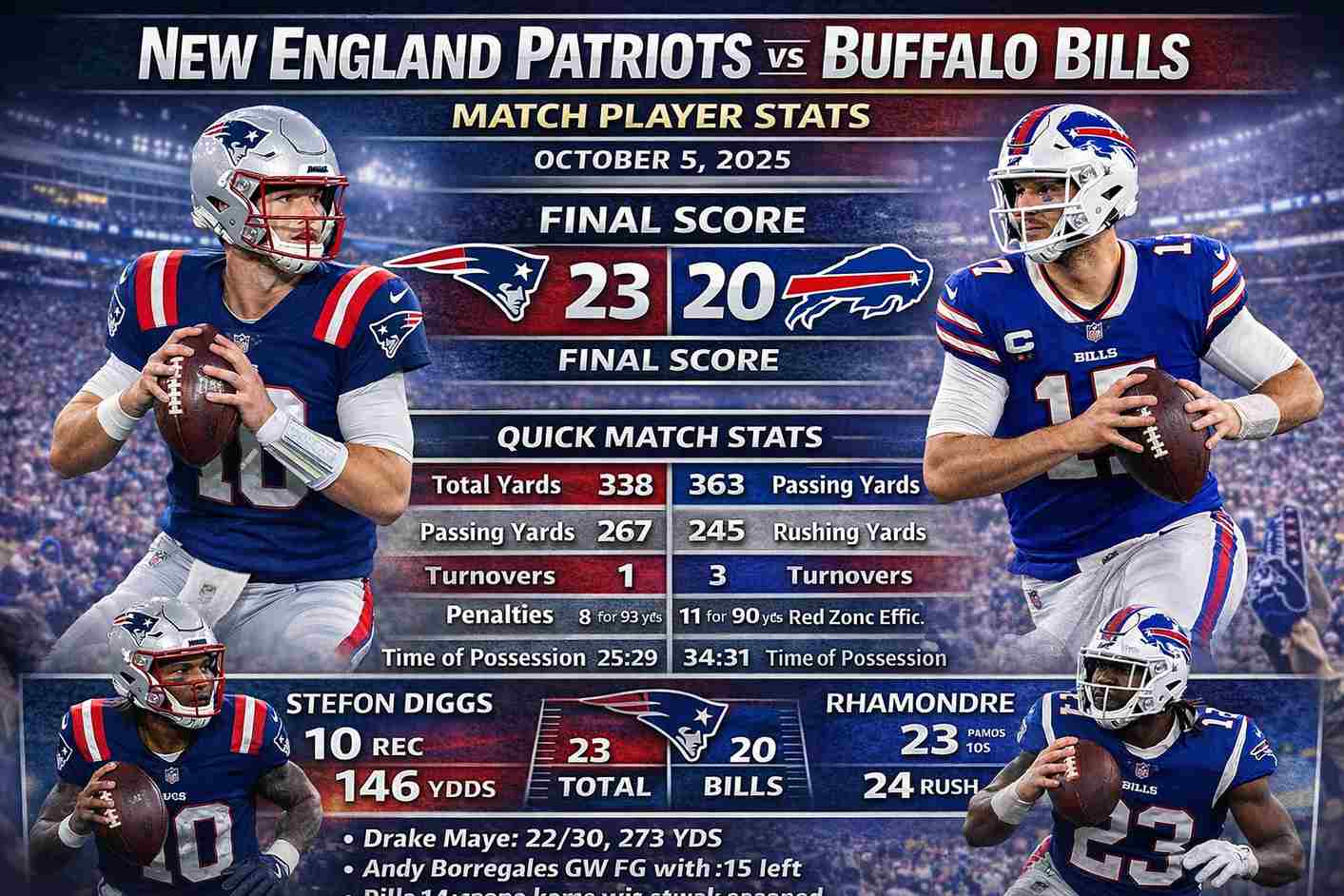
The New England Patriots vs Buffalo Bills match player stats from October 5, 2025, tell the story of one of the most exciting Week 5 games of the 2025 NFL season. The game took place at Highmark Stadium in Orchard Park, New York, with kickoff set for 8:23 PM EDT. A crowd of 70,802 fans packed the stadium for this primetime Sunday Night Football showdown. Weather conditions were great for football. Skies were clear, temperatures sat at a comfortable 66°F (18.9°C), humidity was 58%, and wind was a light 3 mph from the south. The game was played on an A-Turf Titan artificial surface.
New England walked away with a 23‑20 victory on a dramatic 52-yard field goal by Andy Borregales with just 15 seconds left. The win snapped Buffalo’s 14-game home winning streak at Highmark Stadium and left the NFL with no unbeaten teams five weeks in — the first time that had happened since 2014. Drake Maye went 22 of 30 for 273 yards for the Patriots. Stefon Diggs caught 10 passes for 146 yards in his first return to Buffalo since his 2024 trade. Rhamondre Stevenson scored two rushing touchdowns. For the Bills, Josh Allen threw for 253 yards and two touchdowns but committed two costly turnovers in a three-point loss.
The game aired on NBC and streamed on Peacock and the NBC Sports App. This article covers every key stat, player performance, and game detail you need to know.
Quick Match Stats Table
| Category | New England Patriots | Buffalo Bills |
| Total Yards | 338 | 363 |
| Passing Yards | 267 | 245 |
| Rushing Yards | 71 | 118 |
| Turnovers | 1 | 3 |
| Penalties | 8 for 93 yds | 11 for 90 yds |
| Red Zone Efficiency | 2-4 | 2-4 |
| Time of Possession | 25:29 | 34:31 |
Game Summary and Final Score
The Patriots and Bills delivered a tight AFC East divisional battle at Highmark Stadium in Orchard Park, New York. New England edged Buffalo 23‑20 in a back‑and‑forth contest that came down to the final seconds.
Drake Maye drove the Patriots into field goal range late in the fourth quarter. Kicker Andy Borregales then nailed a 52‑yard field goal with just 15 seconds remaining, sealing the upset and handing Buffalo their first home loss of 2025.
Quick Score Table
| Team | Q1 | Q2 | Q3 | Q4 | Final |
| New England Patriots | 3 | 3 | 7 | 10 | 23 |
| Buffalo Bills | 0 | 3 | 7 | 10 | 20 |
Complete Contextual Match Information
| Category | Details |
| Stadium / Venue | Highmark Stadium (officially Highmark Blue Cross Blue Shield Stadium) |
| City and Country | Orchard Park, New York, United States |
| Match Date | Sunday, October 5, 2025 |
| Match Start Time | 8:23 PM EDT |
| Match End Time | Data not publicly available |
| Tournament / League | NFL 2025 Regular Season |
| Match Stage | Week 5 — AFC East Divisional Regular Season Game |
| Toss Result and Decision | Data not publicly available |
| Weather — Condition | Clear |
| Weather — Temperature | 66°F (18.9°C) |
| Weather — Humidity | 58% |
| Weather — Wind | South at 3 mph |
| Stadium Type | Open / Outdoor |
| Surface / Pitch Type | A-Turf Titan (artificial) |
| Official Attendance | 70,802 |
TV Broadcast Channels
| Country | Channel |
| United States | NBC (Sunday Night Football) |
| United States (out-of-market) | NFL+ |
Streaming Platforms
- Peacock (NBC’s streaming platform)
- NBC Sports App
- NFL+ (out-of-market subscribers)
Match Officials
| Role | Name |
| Referee | Shawn Hochuli |
| Line Judge | Tim Podraza |
| Down Judge | Patrick Holt |
| Side Judge | Jason Ledet |
| Umpire | Larry Smith |
| Field Judge | Jim Quirk |
| Back Judge | Jimmy Russell |
Special Incidents
- Patriots RB Antonio Gibson suffered a knee injury returning a kickoff 6 minutes into the second quarter and did not return.
- Bills LB Matt Milano aggravated a pectoral injury and did not return. DT Ed Oliver missed his fourth straight game with a sprained ankle.
- Bills C Connor McGovern left briefly for hand tests but returned.
- Josh Allen muffed a handoff to Dawson Knox on Buffalo’s opening drive.
- Marcus Jones intercepted Allen at New England’s 10-yard line.
- Keon Coleman fumbled at his own 11-yard line — three total Bills turnovers.
- Buffalo’s 14-game Highmark Stadium home win streak was snapped.
- Stefon Diggs made his first return to Orchard Park since being traded to Houston in April 2024.
- This game eliminated the NFL’s last unbeaten team, the first time since 2014 that no team started 5‑0.
Understanding New England Patriots vs Buffalo Bills Match Player Stats in Context
Raw numbers alone don’t tell the full story of this rivalry. Passing yards, completion percentage, and rushing attempts are standard offensive statistics, but situational efficiency separates good analysis from great analysis.
Defensive statistics like total tackles, sacks, interceptions, and forced fumbles often determine outcomes more than yardage totals. In this game, Buffalo’s three turnovers were more damaging than any individual stat line.
Special teams metrics — including field goal percentage, net punting average, and kick return yardage — also shaped the result. Andy Borregales’ field goal accuracy beyond 40 yards directly decided the final score.
Quarterback Performance Analysis
Buffalo Bills Quarterback Trends
Josh Allen’s dual-threat ability is the engine of Buffalo’s offense. His completion percentage under pressure, yards per attempt on play action, and red zone touchdown rate are the key metrics to track in any Bills game.
When Allen controls third-down conversions, avoids turnovers, and adds rushing yards on designed quarterback runs, Buffalo dominates time of possession. On October 5, he finished 22 of 31 for 253 yards with two touchdowns, but two turnovers erased that production.
New England Patriots Quarterback Trends
Drake Maye’s style contrasts sharply with Allen’s. The Patriots rely on quick-release passing, short to intermediate route precision, and strict ball security.
Maye’s low average depth of target and efficient completion percentage reflect a structured system built around clock management. When his third-down conversion rate exceeds 40 percent, and turnovers stay at zero or minimal, New England stays competitive against any opponent.
New England Patriots Offensive Stats
The Patriots generated 338 total yards on a balanced mix of passing and rushing plays. Drake Maye was near-perfect, completing 22 of 30 passes for 273 yards and going 13 of 14 for 184 yards in the second half alone.
Stefon Diggs led the receiving corps with 10 receptions for 146 yards, 119 of which came after halftime. His route precision and ability to create separation against his former team kept drives alive at critical moments.
Rhamondre Stevenson grounded the attack with 71 rushing yards and two touchdowns on 4‑yard and 7‑yard runs, giving New England a balanced offensive attack that controlled the clock in the fourth quarter.
Buffalo Bills Offensive Stats
Buffalo totaled 363 yards — more than New England —, but three turnovers prevented those yards from becoming points. Josh Allen threw for 253 yards and two touchdowns while adding 53 rushing yards, showcasing his dual-threat capability on both vertical routes and designed runs.
Dalton Kincaid was Buffalo’s most consistent weapon with 108 receiving yards on six receptions. His athleticism and strong hands maintained drive continuity, but multiple Bills drives stalled inside New England territory due to penalties and self-inflicted errors.
The Bills were flagged 11 times for 90 yards, with coach Sean McDermott calling it “sloppy” football after the game.
Quarterback Performance Comparison
| Stat | Drake Maye (NE) | Josh Allen (BUF) |
| Completions | 22/30 | 22/31 |
| Passing Yards | 273 | 253 |
| Touchdowns | 1 | 2 |
| Interceptions | 0 | 1 |
| Rushing Yards | — | 53 |
| Turnovers | 0 | 2 |
Maye’s composure in the second half — 13 of 14 for 184 yards — was the difference. Allen’s dual-threat output was strong statistically, but turnover avoidance ultimately defined which quarterback won the game.
Top Offensive Player Performances
Stefon Diggs delivered the standout performance of the night. Catching 10 passes for 146 yards against his former team in a primetime game, Diggs consistently moved the chains and created explosive plays against Buffalo’s secondary.
Rhamondre Stevenson’s two rushing touchdowns added complementary scoring that kept New England’s drive totals efficient. His physical running style helped control the time of possession and limited the Bills’ opportunities late in the game.
For Buffalo, Dalton Kincaid’s tight end production stood out with 108 receiving yards, proving tight end play remains central to modern offensive schemes even in closely contested divisional matchups.
Rushing and Receiving Leaders
Buffalo Bills Ground Production
Buffalo’s ground game uses zone read concepts and designed quarterback runs to make play action credible. When the Bills average above 4.5 yards per carry, their offense becomes significantly harder to stop. James Cook was held to 49 yards on 15 carries — his first game under 100 scrimmage yards this season — which neutralized that element entirely.
Patriots Rushing Strategy
New England’s gap scheme runs, and a rotational backfield approach prioritizes conversion rate on third and short over total rushing yards. Stevenson’s goal-line success on two touchdown runs showed how the Patriots use the ground game as a scoring tool rather than a yardage accumulator.
Buffalo Receiving Production
Dalton Kincaid’s 108 yards on six receptions reflected strong yards per route run and a high catch rate under coverage. His target share percentage and chunk play production kept Buffalo’s offense moving even when the run game stalled.
Patriots Receiving Production
Diggs’ 146 yards came largely through separation rate, yards after catch, and third-down reception percentage. His YAC numbers signaled a well-designed short passing scheme rather than deep vertical dominance — exactly the type of production that sustains drives in tight games.
Running Back Impact and Ground Game Efficiency
Rhamondre Stevenson’s two rushing touchdowns forced Buffalo’s defense to respect the ground attack, which opened passing lanes for Maye throughout the second half. His ability to pick up tough yards on short yardage situations was critical to New England’s clock management strategy.
James Cook’s limited production — 49 yards on 15 carries — disrupted Buffalo’s offensive rhythm. Cook had scored a rushing touchdown in eight consecutive games heading into Week 5. Holding him well below his season average fundamentally changed what Buffalo could do offensively.
Wide Receiver and Tight End Contributions
Stefon Diggs’ return to Orchard Park added a narrative dimension to a statistically dominant night. His route-running precision and ability to secure catches in tight coverage gave Maye a reliable chain-mover on nearly every key third down.
On the Bills’ side, Dalton Kincaid demonstrated the value of tight end mismatches in modern NFL offenses. His six receptions for 108 yards came against a Patriots secondary that had limited most opposing receivers all season.
Keon Coleman’s fumble at his own 11-yard line, however, offset his contributions and directly handed New England a favorable field position at a crucial moment.
Defensive Stats and Notable Performances
Buffalo Defensive Stats
Buffalo generated pass coverage pressure on Maye at times, but missed tackles on third downs allowed New England to sustain key drives. The Bills’ inability to generate a takeaway — while giving up three on offense — created an uneven turnover differential that proved decisive.
Patriots Defensive Metrics
New England’s front seven limited the Bills’ rushing attack to 118 yards and held James Cook well below his season average. Marcus Jones’ interception at New England’s 10-yard line stopped a promising Buffalo scoring drive and swung momentum firmly to the Patriots.
Holding Buffalo under 35 percent on third down during key stretches allowed the Patriots to keep the game close despite losing the time of possession battle 34:31 to 25:29.
Turnovers, Penalties, and Special Teams Impact
Turnover Battle and Game-Changing Moments
Buffalo’s three turnovers — including Allen’s muffed handoff to Dawson Knox, Marcus Jones’ interception, and Keon Coleman’s fumble — were the defining factor in a three-point game. Each turnover directly shifted field position and momentum at critical times.
New England committed just one turnover, maintaining discipline while Buffalo self-destructed at key moments. Points scored off turnovers tipped the balance firmly toward the Patriots.
Andy Borregales’ 52-yard field goal with 15 seconds remaining was the decisive special teams moment. His field goal accuracy beyond 40 yards, combined with New England’s net punting average and starting field position throughout the game, made special teams a genuine competitive advantage in this matchup.
Red Zone Efficiency Breakdown
Both teams finished 2 for 4 in the red zone, making efficiency inside the 20 a draw on paper. But the quality of those possessions differed significantly.
Bills Red Zone Metrics
Buffalo’s red zone struggles came from self-inflicted penalties and turnover timing — including the Coleman fumble at their own 11 and Allen’s interception near midfield. Their play-action scoring efficiency and quarterback rushing touchdown potential were neutralized by discipline breakdowns before they could reach scoring range.
Patriots Red Zone Metrics
New England’s power run success rate inside the red zone was decisive. Stevenson’s two short rushing touchdowns came from gap scheme execution and goal-line efficiency. The Patriots avoided settling for field goals in red zone trips, while Buffalo’s short passing touchdown ratio was limited by turnovers that ended drives prematurely.
Special Teams Influence
Special teams decided this game as much as any offensive or defensive play. Andy Borregales’ field goal accuracy beyond 40 yards — including the game-winning 52-yarder — was the margin of victory.
Matt Prater’s 45-yard field goal for Buffalo tied the game at 20 with 2:17 remaining, but New England’s response drive and Borregales’ clutch kick made starting field position and net punting average irrelevant in the final calculation.
Antonio Gibson’s knee injury on a kickoff return in the second quarter also impacted New England’s special teams rotation for the remainder of the game.
Implications for AFC East Standings
New England improved to 3‑2, moving within one game of Buffalo in the AFC East division standings. The Patriots recorded back-to-back wins for the first time since 2022 and achieved a winning record through five games for the first time since opening the 2019 season 8‑0.
Buffalo dropped to 4‑1 with their home win streak snapped at 14 games — one short of the franchise record. While playoff chances remained strong, ball security, red zone efficiency, and penalty discipline became urgent priorities heading into the Atlanta road game on October 13.
Historical Rivalry Context
During the Patriots’ dynasty era, New England controlled possession, limited explosive plays, and consistently won low-scoring divisional games. The AFC East landscape has shifted significantly in recent seasons, with Buffalo’s offensive evolution producing higher-scoring, more dynamic matchups.
The October 5 game reflected both realities — a modern, higher-volume passing environment with quarterback mobility central to both offenses, layered over the traditional situational football that has always defined this rivalry. Increased passing volume league-wide and more aggressive fourth-down decisions have changed how these stats are interpreted compared to historical profiles from even five years ago.
Advanced Metrics That Matter Most
Beyond traditional box score stats, EPA per play and success rate better reflect true performance impact in tight divisional games. Maye’s EPA per play in the second half was among the highest of any quarterback in Week 5.
Pressure to sack conversion rate explains why Allen’s dual-threat ability created stress on New England’s defense without translating into points. Defensive coverage grades for Marcus Jones and the Patriots’ secondary confirmed their performance was scheme-driven, not accidental.
Real World Application of Player Stats
For fantasy football managers, Stevenson’s red zone touches and Diggs’ target volume matter more than their total yards in isolation. Both finished as high-value plays precisely because of role clarity and red zone efficiency.
For bettors, turnover trends and third-down efficiency provided deeper predictive value than headline yardage numbers heading into this game. For coaches and analysts, New England’s defensive alignment success and Buffalo’s pressure rate data offer direct predictive value for the Week 12 rematch.
Challenges in Interpreting Match Player Stats
Small Sample Size
One game does not define season-long ability. Allen’s two turnovers were outliers relative to his 2024 MVP season performance.
Garbage Time Inflation
Late-game passing yards can inflate quarterback stats. Allen’s second-half yardage partially reflected New England’s prevent defense.
Weather Factors
Clear skies and 66°F temperatures at Highmark Stadium on October 5 minimized weather impact on passing efficiency — a variable that matters far more in late-season Buffalo games involving wind and cold conditions.
Injury Impact
Antonio Gibson’s knee injury and Matt Milano’s pectoral aggravation altered both teams’ personnel groupings. A missing linebacker or offensive lineman shifts statistical performance in ways raw numbers rarely capture.
Conclusion
The October 5, 2025 Patriots vs Bills game delivered everything a divisional rivalry should — clutch kicking, turnover drama, a quarterback duel, and AFC East implications decided in the final 15 seconds.
Drake Maye’s second-half composure, Stefon Diggs’ 146-yard homecoming, and Andy Borregales’ game-winning field goal gave New England a resilient road win. Buffalo’s three turnovers and 11 penalties ultimately cost them a home game they controlled statistically but lost situationally.
Understanding these match player stats through the lens of red zone execution, turnover timing, and quarterback decision making reveals why the final score reflected the game’s true competitive balance.
Frequently Asked Questions
What was the final score of the Patriots vs Bills game on October 6, 2025?
New England Patriots 23, Buffalo Bills 20. The Patriots won on a 52-yard Andy Borregales field goal with 15 seconds remaining.
Who led the game in receiving yards?
Stefon Diggs led all receivers with 146 yards on 10 receptions, including 119 yards in the second half.
Did this game affect the Bills’ home winning streak?
Yes. New England snapped Buffalo’s 14-game Highmark Stadium home winning streak, one short of the franchise record.
Who kicked the game-winning field goal?
Andy Borregales kicked a 52-yard field goal with 15 seconds left to give New England the 23-20 victory.
How many turnovers did each team have?
The Patriots committed one turnover. The Bills committed three — two by Josh Allen and one by Keon Coleman.
What are the most important player stats in Patriots vs Bills games?
Turnover margin, third-down conversion rate, red zone efficiency, and quarterback pressure rate are the most predictive metrics in this rivalry.
How does quarterback mobility impact this matchup?
Mobile quarterbacks like Josh Allen extend drives, convert broken plays, and stress defensive contain responsibilities — increasing explosive play potential and making defensive coordination significantly harder.
Why are red zone stats more important than total yardage?
Total yardage does not guarantee points. Red zone efficiency directly determines whether drives end in touchdowns or field goals, which is what separates winning and losing teams in close divisional games.
Do weather conditions affect passing stats in Buffalo?
Yes. Wind and cold temperatures at Highmark Stadium in late-season games reduce deep passing accuracy and force conservative play calling. The October 5 game benefited from mild 66°F conditions, which minimized that factor.
How can fans analyze player stats more effectively?
Focus on situational performance — third down conversions, red zone plays, turnover timing, and yards after contact — rather than total yardage. These metrics reflect genuine game impact far better than headline numbers.
