

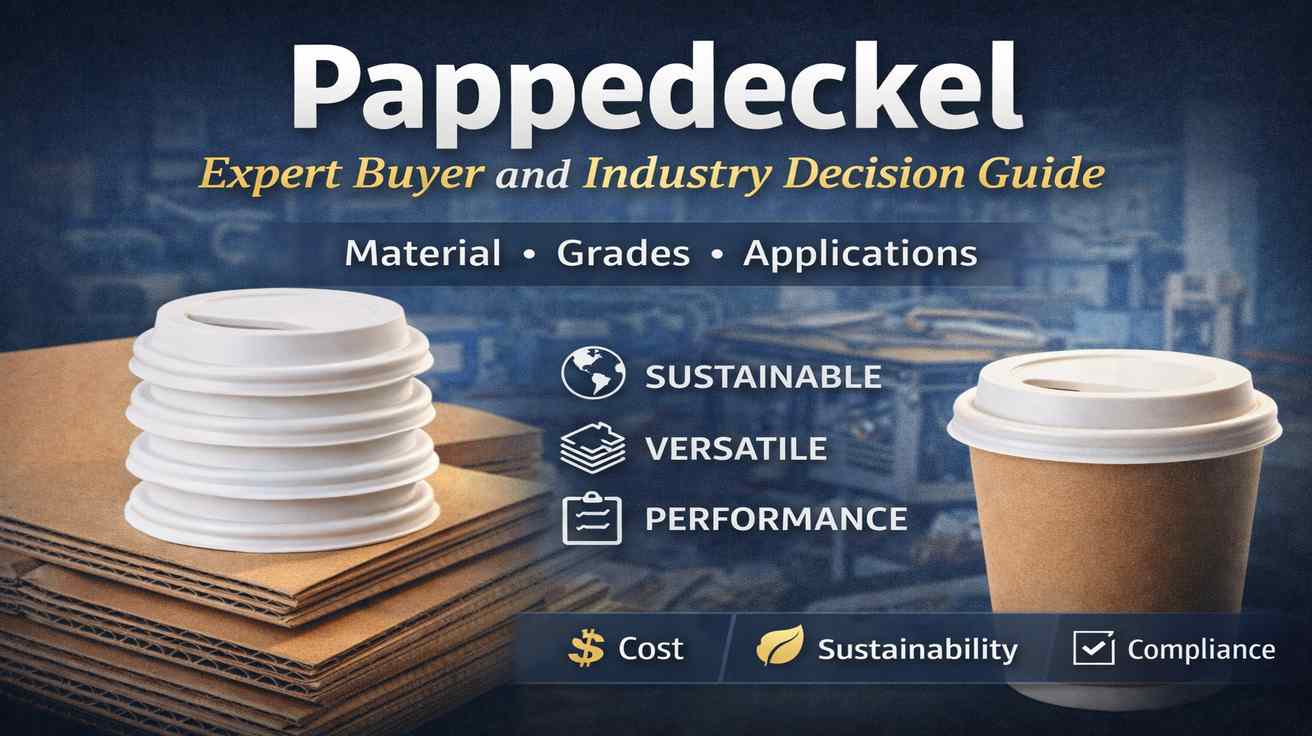
If you source, specify, or work with packaging materials, understanding pappedeckel goes beyond knowing it is a cardboard lid. It is a material category with distinct types, performance grades, and sustainability credentials that directly affect procurement decisions, brand positioning, and regulatory compliance. This guide breaks down everything decision-makers, buyers, and industry professionals need to evaluate and select the right pappedeckel solution.
Pappedeckel Explained: Material, Composition, and Core Properties
Pappedeckel comes from German — Pappe meaning cardboard and Deckel meaning lid or cover. In practical terms, it describes a category of thick paperboard products used as lids, covers, protective layers, and structural inserts across packaging, food service, and industrial applications.
Its core value lies in a combination of properties that few single materials match: lightweight construction, adaptable thickness and density, reliable structural support, and compatibility with eco-conscious industries shifting away from plastic alternatives.
The base material is paperboard — compressed paper fibers pressed into flat sheets of varying thickness. Depending on the application, manufacturers apply natural coatings for heat resistance or water resistance, turning a basic sheet into a functional, performance-grade product.
Raw Material Breakdown
The material composition varies by product grade:
- Recycled paperboard — compressed from recycled paper fibers; the standard base for most grades
- Wood fibers — used in premium grades requiring higher density and durability
- PLA (polylactic acid) — a biodegradable film derived from corn starch or sugarcane; applied as a moisture-resistant surface layer
- Wax coatings — added for liquid resistance in hot beverage and food service applications
- Biodegradable films — replace plastic polymers in coated versions
- Mixed fiber layers with binders — bonded under heat using plant-based or synthetic binders for multi-layer construction
- Paper pulp base — the starting point for all grades before pressing and finishing
Physical Properties That Define Performance
| Property | How It Is Achieved |
| Compression strength | Multiple layers are bonded under high pressure |
| Moisture resistance | PLA or wax surface treatments |
| Heat resistance | Coated finishing layers |
| Sogginess resistance | Sealed surface coatings on food-grade versions |
| Durability | Dense fiber composition and finishing process |
| Flat sheet stability | Controlled drying after high-pressure pressing |
Pappedeckel Product Types: Which One Fits Your Application?
Three primary product types cover the majority of commercial and industrial applications. Selecting the wrong type leads to performance failures, increased waste, and higher replacement costs.
Greyboard
Greyboard is a dense, recycled cardboard sheet primarily used where structural support and rigidity matter more than moisture performance. Common applications include book covers, packaging inserts, and storage boxes. It offers reliable compression resistance at a lower cost than coated grades.
Corrugated Cardboard
Corrugated pappedeckel features a fluted inner layer between two flat sheets. This structure delivers superior shock absorption, making it the standard choice for shipping boxes, fragile item protection, and logistics packaging across bulk orders. It absorbs impact without significantly adding weight.
Solid Cardboard Sheets
Smooth flat boards without fluting. Used across arts, crafts, industrial protective layering, and surface protection applications. This type offers the cleanest printable surface and the most flexibility for cutting and shaping.
Where Pappedeckel Is Used: Industry-by-Industry Breakdown
Pappedeckel serves distinct functions across industries. Understanding sector-specific requirements helps buyers specify the correct grade and coating.
Food and Beverage Sector
This sector drives the highest volume of pappedeckel consumption globally. Key applications include:
- Lids for takeaway coffee cups and hot beverages
- Covers for soup containers, salad containers, and grain bowls
- Protective inner layers inside pizza boxes and bakery boxes
- Cardboard coasters under glasses in cafes and restaurants
- Covers for pastries, desserts, and leftover food containers
Temperature maintenance, spill prevention, and freshness retention are the three performance requirements driving material specification in food service. Coated grades are standard for takeout drinks and hot food applications.
Packaging and Logistics Sector
Industrial and commercial packaging relies on pappedeckel for:
- Protective inserts inside shipping containers
- Dividers between fragile items in bulk shipments
- Flat covers for jars and tubs
- Floor protection during warehouse operations
- Layering between metal sheets and machinery parts in transit
Packaging companies managing high-volume e-commerce fulfillment favor corrugated grades for their shock-absorbing performance and low weight-to-protection ratio.
Bookbinding and Print Sector
The rigid core of hardcover books is almost always a greyboard grade of pappedeckel. It provides the structural backbone beneath decorative covers. Other applications include display boards, models, and scrapbooking bases used by hobbyists and print professionals.
Construction and Industrial Sector
Thick cardboard sheets protect floors during renovations and construction work, preventing scratch damage to finished surfaces. In manufacturing, pappedeckel acts as a temporary protective layer between metal sheets and machinery parts during shipping and installation, with shock-absorbing properties reducing damage risk during transport.
Pappedeckel Manufacturing: From Pulp to Finished Product
Understanding the production process helps buyers assess quality claims and evaluate supplier specifications.
The process follows these stages:
- Pulping — recycled paper pulp or wood fibers are mixed with water to form a slurry
- Sheet formation — the slurry is spread and pressed into flat sheets
- High-pressure compression — excess moisture is removed under high pressure
- Drying — sheets are dried to the target moisture content
- Layer bonding — multiple layers are bonded using binders under heat for added density
- Surface treatment and finishing — coatings are applied for water resistance, heat resistance, or moisture prevention
- Quality testing — finished sheets are tested before entering paper recycling systems or product lines
The production sequence determines final thickness, compression strength, and coating performance. Buyers specifying food-grade or industrial-grade pappedeckel should request data on coating type and layer count, as these directly affect functional performance.
Sustainability Credentials: What the Data Actually Shows
Pappedeckel’s environmental profile is stronger than most packaging alternatives — but the full picture depends on sourcing and end-of-life handling.
Certified Sourcing and Forest Management
Responsible production starts with raw material sourcing. Manufacturers using wood fibers from certified forests operate under sustainable forestry standards that maintain ecological balance and prevent deforestation. FSC-certified sourcing limits carbon emissions associated with raw material extraction and ensures sustainably sourced fibers replace virgin materials over time.
Buyers should request sourcing certification data from suppliers. This directly affects a product’s carbon footprint and supports compliance with environmental regulations across the EU and global markets.
End-of-Life Impact
| End-of-Life Path | Environmental Outcome |
| Recycling | Conserves energy and water vs. virgin production; reduces virgin materials demand |
| Composting | Achieves soil enrichment; avoids landfill contribution |
| Landfill | Biodegrades significantly faster than plastic; no microplastic pollution |
| Incineration | Lower toxic emissions than plastic polymers |
When managed through recycling programs, paperboard production requires less energy and water conservation compared to producing new material from scratch. This supports circular economy goals and reduces the overall waste management burden.
The key condition remains consistent: compostable and recyclable claims only deliver full environmental benefit when packaging systems and local infrastructure support correct disposal. Emissions and pollution from poorly managed disposal offset gains made during production.
Pappedeckel vs Plastic: A Direct Performance Comparison
| Feature | Pappedeckel | Plastic Lid |
| Biodegradable | Yes | No |
| Recyclable | Yes — most systems | Type-dependent |
| Decomposition rate | Weeks to months | Hundreds of years |
| Landfill waste contribution | Low | Very high |
| Moisture resistance | Moderate (cardboard treatments required) | High — no treatment needed |
| Environmental footprint | Significantly lower | Higher |
| Microplastic pollution risk | None | Present |
| Seal performance | Good for short-term food use | Strong for long-term durability |
| Renewable raw materials | Yes | No |
| Sustainable choices alignment | Strong | Weak |
Plastic polymers maintain a performance edge in full waterproofing and long-term durability. For most food service and packaging applications requiring short-term sealing, pappedeckel matches or exceeds plastic performance while delivering a materially lower environmental impact.
Buying and Sourcing Pappedeckel: What Decision-Makers Need to Know
Procurement decisions on pappedeckel involve more variables than price per unit. Grade selection, coating specification, customization options, and supplier reliability all affect total cost and performance outcomes.
Cost and Customization Factors
Pappedeckel is affordable relative to plastic alternatives and metals across most volume tiers. Key cost and customization considerations:
- Cut and shape flexibility — sheets can be cut, folded, printed, and shaped to specification without specialist tooling
- Print surface — solid cardboard sheets offer the cleanest surface for brand logos, product information, and design
- Branding value — customized printed lids and covers serve both functional and brand image purposes
- Volume pricing — bulk orders reduce per-unit cost significantly; small businesses can access competitive pricing through packaging distributors
- Shipping expenses — lightweight grades reduce freight costs versus heavier alternatives
Professional appearance matters in food service and retail. A well-specified pappedeckel product communicates quality and reinforces brand positioning without requiring premium packaging materials.
Storage and Handling Requirements
Improper storage is the primary cause of performance failure before use:
- Store in dry conditions away from humidity at all times
- Keep sheets flat to prevent warping and maintain structural integrity
- Avoid exposure to steam or water during storage — coatings do not fully protect against prolonged moisture absorption
- Use coated grades in high-moisture environments to prevent sogginess
- Maintain stable temperature conditions away from direct heat sources for optimal performance
Strengths, Limitations, and Ideal Use Cases
Strengths
- Lightweight and affordable across all volume levels
- Customizable — cut, folded, printed, and shaped without specialist equipment
- Durable enough for short-term food service, packaging, and industrial protective use
- Strong structural support in greyboard and corrugated grades
- Effective sealing for food and beverage applications with correct coating
- Full recyclability and biodegradability
Limitations
- Not fully waterproof without added coating — uncoated grades weaken under moisture
- Sealing performance degrades in high-humidity conditions over time
- Not suited for heavy storage requiring long-term durability
- Water resistant only to the level of its applied coating — not inherently so
- Coating requirements add cost for moisture-intensive applications
Ideal Use Cases by Grade:
| Grade | Best For | Avoid For |
| Greyboard | Book covers, packaging inserts, storage | Hot liquid contact |
| Corrugated | Shipping, fragile items, bulk logistics | Direct food contact |
| Solid Sheets | Food lids, print, crafts, protection | Long-term outdoor use |
Creative, DIY, and Alternative Applications
Beyond commercial use, pappedeckel has a strong following among designers, makers, and educators. Its low cost and workability make it the default prototyping material across multiple creative disciplines.
Applications include:
- Architectural scale models and cardboard structures for design prototyping
- Stage props and exhibition displays with natural texture appeal
- Eco-friendly design projects using decorative paper layering
- Gift tags and bookmarks finished with paint or printed detail
- Plant markers for herbs and vegetables in garden settings
- Pantry organization using labeled covers on jars and containers
- School projects, art installations, and surface protection during painting
The material’s natural texture also adds aesthetic appeal in eco-friendly design contexts where raw, uncoated surfaces are a deliberate design choice.
Zero-Waste Integration: Pappedeckel in Sustainable Lifestyles
For consumers and businesses committed to zero-waste goals, pappedeckel fits at multiple points in the waste reduction cycle:
- Reuse — repurpose as coasters, plant tags, or craft material before disposal
- Recycle — accepted in standard paper recycling systems in most regions
- Compost — breaks down without toxic residue under composting conditions
- Replace — substitutes plastic containers and lids in food service and home use
Paperboard packaging systems built around circular economy principles reduce landfill contribution at scale. Environmental health outcomes improve when businesses combine biodegradable product choices with active participation in local recycling programs.
Economic and Market Significance of the Cardboard Industry
The cardboard industry generates significant economic activity across the full supply chain — from forestry and pulp processing through manufacturing, packaging companies, and recycling plants. Jobs exist at every stage, with growth concentrated in e-commerce fulfillment and sustainable packaging sectors.
For small businesses, pappedeckel provides access to professional packaging at affordable price points without minimum order volumes that would otherwise restrict entry. As global shipping and online shopping volumes continue rising, demand for lightweight protective packaging materials expands with them.
Responsible consumption trends are pushing credibility toward brands that demonstrate sustainable material choices. Pappedeckel adoption supports both cost management and market positioning across local and international reach segments.
Innovation Roadmap: Next-Generation Pappedeckel Materials and Technologies
The performance gap between pappedeckel and plastic is narrowing. Current development priorities include:
- Biodegradable coatings — replacing synthetic surface treatments with plant-derived alternatives that maintain moisture-resistant performance
- Plant-based adhesives — eliminating synthetic binders from multi-layer construction
- Natural coatings with fire resistance — extending industrial applications into higher-risk environments
- Stronger recycled fiber blends — improving structural strength without increasing weight or thickness
- Surface smoothness improvements — enabling higher-resolution brand communication through print
- Single-use plastic regulations — accelerating adoption of paper-based packaging across the EU, UK, and North American markets
- Government plastic reduction mandates — creating regulatory tailwinds for eco-friendly designs across packaging categories
Consumer demand continues shifting toward sustainable choices. Combined with tightening environmental regulations and expanding circular economy infrastructure, the technology investment case for next-generation pappedeckel is strong through 2026 and beyond.
Conclusion
Pappedeckel is a versatile, adaptable material that serves critical functions across food service, industrial protection, construction, logistics, bookbinding, and creative applications. Its affordability and practical design make it accessible to small businesses and large packaging operations alike. Its responsible packaging credentials — recyclable, biodegradable, compostable, and sourced from renewable materials — align directly with sustainability goals that are now purchasing criteria, not optional extras.
Greener materials do not always require compromising on performance. For the majority of short-term packaging, food service, and protective applications, pappedeckel delivers what plastic does — at a lower environmental cost and with a clearer pathway toward circular economy outcomes. Small changes in material specification create a big impact at scale.
FAQs
What makes pappedeckel different from regular cardboard?
Pappedeckel is defined by its compressed paper fiber construction, controlled thickness and density, multiple bonded layers, and surface treatments or finishing coatings. These properties give it structural support and durability beyond standard single-layer cardboard sheets.
Which pappedeckel type is best for food packaging?
Coated grades using PLA or wax coatings are best for food packaging. These provide moisture resistance and heat resistance while preventing sogginess. For short-term food service and sealing applications, coated solid cardboard sheets are the most reliable specification.
How does pappedeckel support zero-waste goals?
It supports zero-waste goals through three pathways: it is recyclable in most paper systems, compostable under the right conditions, and biodegradable in landfills — unlike plastic containers that persist for centuries. Repurposing before disposal extends the life cycle further.
Is pappedeckel cost-effective for small businesses?
Yes. It is affordable relative to plastic alternatives and metals, particularly at bulk order volumes. Customizable printing, cutting, and folding options are accessible without specialist tooling, making it a practical choice for small businesses managing both cost control and brand image.
What are the storage requirements for pappedeckel?
Store in dry conditions away from humidity. Keep sheets flat to maintain structural integrity. Avoid direct moisture exposure before use. Apply coatings appropriate to the use environment. Stable temperature and controlled humidity deliver optimal performance and prevent premature moisture absorption.
How is pappedeckel manufactured at scale?
Production moves from recycled paper pulp or wood fiber slurry through high-pressure compression, drying, layer bonding with binders under heat, surface finishing with coatings, and final quality testing before entering product lines or paper recycling systems.
What innovations are improving pappedeckel durability?
Current innovations focus on biodegradable coatings replacing synthetic treatments, plant-based adhesives replacing synthetic binders, stronger recycled fiber blends improving structural strength, and improved surface smoothness enabling better brand communication. Fire resistance coatings are also extending industrial use cases.
Which industries rely most heavily on pappedeckel?
Food service and cafes represent the highest volume sector, followed by e-commerce packaging, logistics, manufacturing, construction, bookbinding, and restaurants. Packaging companies serving multiple end markets are the primary commercial buyers.
