

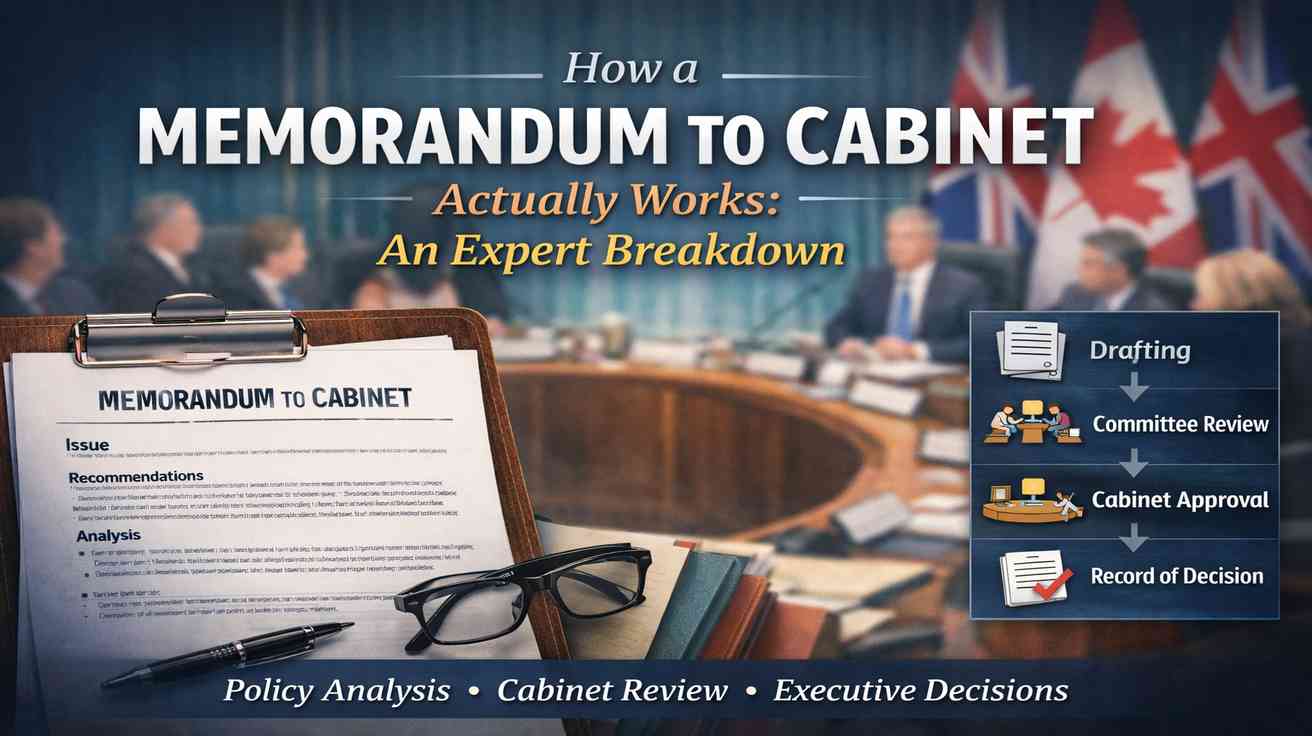
A memorandum to cabinet is not just a government form — it is the formal policy instrument through which civil servants and ministers convert proposals into binding executive decisions. In Westminster parliamentary systems, no major government action moves forward without one.
This breakdown is written for policy analysts, senior civil servants, and public administration students who need more than a basic definition. It covers how the MC functions within the cabinet decision-making system, what separates strong submissions from weak ones, and what the approval workflow actually looks like from sponsoring department to Record of Decision.
The Role of a Memorandum to Cabinet in Executive Decision-Making
The MC sits at the intersection of strategic planning, political considerations, and collective governance. It is the mechanism through which ministerial proposals enter the formal cabinet process — structured, evidence-based, and accountable.
Unlike informal briefings or departmental reports, the memorandum to cabinet carries legal and procedural weight. It triggers deliberations that produce government-wide decisions. Every minister at the table is accountable for the outcome — not just the one who submitted it.
This is what makes the MC the backbone of executive decision-making. It forces policy analysis before action, not after.
How It Differs From Other Government Documents
Many civil servants confuse the MC with similar documents. The distinction matters.
| Document | Purpose | Binding Outcome |
| Memorandum to Cabinet | Seeks formal collective cabinet approval | Yes — produces Record of Decision |
| Briefing note | Informs a minister on an issue | No |
| Cabinet brief | Summarizes the background ahead of meetings | No |
| Policy paper | Presents analysis for discussion | No |
A briefing note informs. A memorandum to cabinet decides. The MC carries policy instrument authority — including the power to authorize legislation, spending, and regulatory direction. A cabinet committee reviews it before full ratification. No other government document does that.
Why Cabinet Confidence Rules Exist
The MC is classified at a high security level for a reason. Cabinet confidence rules protect the integrity of deliberations. When ministers know their internal debate is shielded from public scrutiny, they can engage honestly with complex issues without external pressure distorting the discussion.
Leaks compromise this. They force premature public positions before the cabinet has reached consensus. Governments take confidentiality seriously not to hide decisions, but to protect the quality of the process that produces them. Secrecy in this context is a governance tool, not an accountability gap. Transparency follows after decisions are made and authorized.
When Ministers Must Submit a Memorandum to Cabinet
The MC threshold is not arbitrary. It reflects the weight of the decision. Ministers are required to submit one when a proposal qualifies as a formal decision item — particularly when it is controversial, spans multiple jurisdictions, or implicates ministerial responsibilities across portfolios.
Core triggers include:
| Trigger | Description |
| New policy or initiative | Requires a formal cabinet mandate before launch |
| Substantive change to existing program | Significant scope, funding, or eligibility changes |
| Legislative proposals to Parliament | Bills, amendments, or regulatory changes |
| Fiscal framework impact | New appropriations or multi-year budget commitments |
| Multiple departments affected | Cross-ministry coordination required |
| Parliamentary committee response | Formal government reply required |
| Speech from the Throne or Budget commitment | Implementation requires cabinet authority |
| Prime Minister or Cabinet directive | Directed action requires formal authorization |
| Controversial or jurisdictionally complex | Private members’ bills, motions, and inter-jurisdictional matters |
When strategic weight, financial weight, or legal weight is present, the MC is mandatory. There is no discretion at that threshold.
Anatomy of a High-Quality MC: Section-by-Section Breakdown
The standard MC template follows a consistent structure regardless of jurisdiction. In Canada, the Privy Council Office format caps the Ministerial Recommendations section at five single-spaced pages on legal-sized paper, font 12 points, with a mandatory cover page. PCO officials use this document directly to draft the Record of Decision — so precision in every section is non-negotiable.
The Issue Statement and Ministerial Recommendation
The issue statement is one sentence. It defines the exact question before ministers — the problem requiring resolution. It is the link between the title and every section that follows.
Standard formats:
- Whether to…
- How to…
- Whether and how to…
The recommendations box follows. Written in direct language using focused reasoning, it sets out the specific option recommended after key analysis. It must:
- Identify the recommended course of action clearly
- Define the roles and authorities of all implicated ministers
- Specify the policy instruments involved — legislation, grants, contributions, or regulatory direction
PCO officials draft the Record of Decision from this box. Vague recommendations produce vague authorizations.
Rationale, Background, and Strategic Agenda Alignment
This section establishes the origin of the issue and explains why it requires Cabinet attention now. It draws on policy gaps, previous commitments, stakeholder concerns, data, and research findings.
Strong rationale sections connect the proposal to the government’s strategic agenda — referencing the SFT (Speech from the Throne), Budget, prior Cabinet direction, horizontal programs, and departmental programs where applicable. Background information must be factual and relevant, not a historical narrative.
Proposed Approach, Options, and Business Case
This is the analytical core of the MC. It presents the minister’s recommended option supported by a robust business case — alongside two credible alternatives for ministers to consider.
For each option, the drafter must address:
- Cost and feasibility
- Benefits and risks
- Policy measures and fiscal measures are involved
- Instrument choice analysis covering spending programs and regulation
- Adverse consequences of proceeding and not proceeding
- Risk strategies and mitigation approaches
- Stakeholder support and opposition
- Trade-offs and policy objectives
- Limitations of the proposed approach
Arguments must be balanced. Viable options must be genuine alternatives — not strawmen. Ministers recognize weak analysis quickly, and a stacked options section destroys credibility.
Financial Implications and National Spending Considerations
Every MC must account for national spending clearly. This section covers:
- Short-term costs and long-term budget projections
- Funding sources and their assumptions
- Cost estimates tied to specific fiscal year allocations
- Fiscal impact on existing frameworks
- Financial modeling methodology
Assumptions must be explicit. Cabinet manages national appropriations — vague costing signals that the proposal is not ready. Historical examples like the budget reduction legislation from the Ford administration illustrate how financial rigor in cabinet submissions directly shapes real fiscal outcomes.
Legal Considerations and Compliance Framework
If the proposal requires new legislation, regulatory change, or the exercise of existing authority, this section defines the legal basis. It must address:
- Legal authority for the proposed action
- Required amendments and their scope
- Constitutional limits and statutory limits
- Compliance obligations
- Legislative direction and regulatory direction for implementation
Mandatory Assessments Across Jurisdictions
In Canada and comparable jurisdictions, formal assessments are required before cabinet approval. These are not optional additions — they are compliance requirements.
Standard mandatory assessments include:
- Gender Based Analysis Plus (GBA+)
- Official languages considerations
- Environmental impacts
- Broader policy impacts affecting other jurisdictions
- Time allocations for implementation across departments
These assessments demonstrate that the proposal has been stress-tested against societal and regulatory obligations before reaching the cabinet table.
Implementation Plan and Communications Plan — The Two Critical Annexes
The MC’s two annexes — Annex 1 (Implementation Plan) and Annex 2 (Communications Plan) — are each limited to one page. They are not afterthoughts. Cabinet uses them to judge whether the proposal is genuinely deliverable.
Annex 1 — Implementation Plan must cover:
- Full rollout approach and timeframe
- Key milestones and timeline with key junctures
- When benefits reach the targeted population and beneficiaries
- Stated objectives and how they will be measured
- Departmental responsibilities for execution
- How the initiative will be wound up at the conclusion
Annex 2 — Communications Plan must cover:
- The storyline for the policy announcement
- Key messages for public and sector stakeholders
- Delivery approach for the general public in plain terms
- Public communication strategy across relevant channels
- How the initiative will be presented as a deliverable
A weak annex signals a proposal that has not been thought through to execution. Cabinet committees use these sections to assess operational readiness before ratification.
The MC Approval Workflow: From Sponsoring Department to Record of Decision
The approval path is sequential and non-negotiable. Central review bodies check for compliance and completeness at each stage before the document advances.
Stage 1 — Drafting The sponsoring department builds the MC in consultation with central agencies — primarily the Privy Council Office and Treasury Board Secretariat. Consultations with other ministries must be completed at this stage.
Stage 2 — Cabinet Committee Review The MC goes to a specialized committee first — covering social policy, economic matters, or national security, depending on subject matter. The committee debates substance, challenges the business case, and reviews the analysis.
Stage 3 — Committee Recommendation: If the committee is satisfied, it issues a Cabinet Committee Recommendation. The proposal may be confirmed, modified, or rejected at this stage before it ever reaches the full cabinet.
Stage 4 — Full Cabinet Ratification: The full cabinet reviews the committee recommendation. All ministers vote. The outcome reflects collective agreement — confirmed, modified, or rejected.
Stage 5 — Record of Decision The Privy Council Office issues the formal Record of Decision following cabinet approval. This document authorizes departments and ministries to proceed with the implementation of programs and laws as specified.
The Role of Cabinet Committees in Pre-Ratification Review
Cabinet committees are the gatekeepers of the approval process. Each specialized committee — whether focused on social policy, economic matters, or national security — conducts a substantive debate on the proposal before full cabinet ratification.
Their role is to pressure-test the analysis, identify gaps, and determine whether the MC is ready for the cabinet table. A proposal rejected or significantly modified at the committee stage is sent back for revision, adding weeks to the process.
What the Record of Decision Authorizes
The Record of Decision is not a summary document — it is a legal authorization. Issued by the Privy Council Office, it formally directs departments to proceed with implementation. It specifies what was approved, what milestones apply, and which departments carry responsibility. Programs and laws move forward only based on this formal record.
What Separates Expert Drafters From Average Ones
Drafting an MC requires more than good writing. It demands policy insight, legal review, financial modeling, strategic communication, and the ability to anticipate tough questions before ministers ask them.
Expert drafters:
- Present genuine pros and cons — not selective framing
- Ground cost estimates in explicit assumptions with fiscal year precision
- Apply legal rules rigorously and flag compliance risks early
- Run completeness checks against every mandatory template section
- Submit for the central offices’ review before finalization
- Revise based on feedback without losing analytical coherence
- Align every recommendation with documented government priorities
- Assess delivery risk honestly and propose credible mitigation
The business case must be objective. Instrument choice must be justified. Language must be clear. Options must be real.
Common Mistakes That Weaken an MC
Even experienced teams produce weak submissions under the wrong conditions.
| Mistake | Consequence |
| Rushed analysis under tight deadlines | Weak business case, committee rejection |
| Presenting only the preferred option | Loss of credibility, sent back for revision |
| Vague cost estimates without assumptions | Financial modeling rejected by the Treasury Board |
| Interdepartmental disagreements unresolved | Delays, coordination failures, consensus breakdown |
| Leaks before cabinet ratification | Confidentiality breach, forced public positions |
| Missing completeness on mandatory sections | PCO returns the document before it reaches the committee |
| Weak leadership from the sponsoring minister | Conflicts stall the process, pressure builds |
Urgency is the most common driver of these failures. When ministers push for quick approval, drafters cut corners — and cabinet committees reject what gets submitted.
Real-World Impact: What MCs Have Shaped in Public Policy
The influence of the cabinet memorandum runs through decades of public policy history. On September 16, 1975, President Gerald Ford used a memorandum to his cabinet members to set the agenda for a meeting covering economic updates, domestic policies, child nutrition programs, and budget reduction legislation — a document that illustrates how actionable and consequential these submissions are as historical records.
In parliamentary systems, decisions on food security through agricultural policy adjustments, healthcare access via Medicare reforms, and large-scale infrastructure investments all begin as proposals within an MC. So do social initiatives, national laws, and approved policy frameworks that shape citizens’ lives for years.
The collaboration required to produce a strong MC — across departments, ministries, and central agencies — reflects the broader nature of governance itself. Shared accountability produces more durable outcomes than unilateral decisions ever could. The MC is where that shared accountability becomes formalized.
Key Principles Every Civil Servant Must Internalize
Three principles define whether an MC will succeed or fail — before a single word is written.
Brevity and Clarity The five-page limit exists because ministers manage complex portfolios with competing demands. Plain language is not a stylistic choice — it is a requirement. Technical jargon slows reading and signals that the drafter has not translated analysis into accessible reasoning. Precision in every sentence matters.
Collective Responsibility and Public Unity The MC process produces collectively owned decisions. Once the cabinet approves a proposal, all ministers publicly support it — regardless of the internal debate that preceded it. External unity is mandatory. The structured debate inside the process is what makes that unity legitimate rather than a political performance.
Evidence-Based, Responsible Decision-Making Cabinet confidence exists to protect deliberations — but the quality of those deliberations depends on honest, evidence-based submissions. Informed collective action requires that every option is presented with its real strengths, weaknesses, and trade-offs. Responsible decisions on complex public issues cannot come from incomplete or biased analysis.
Conclusion
The memorandum to cabinet is one of the most consequential documents in democratic governance — and one of the least visible. Effective government depends on civil servants who understand not just the template, but the analytical discipline behind it.
Shared decisions that hold up under scrutiny come from submissions that present genuine options, honest trade-offs, and realistic implementation plans. Unity across government branches is only credible when the process that produced the decision was rigorous.
For policy analysts and civil servants, mastering the MC is not a procedural exercise. It is the foundation of responsible, evidence-based governance — where complex public issues become outcomes that last, ministers and departments align around collective approval, and trust in institutions is earned one accountable decision at a time.
FAQs
What is the primary purpose of a memorandum to cabinet?
A memorandum to cabinet is a formal policy instrument that gives a minister the mechanism to seek collective cabinet approval for a major public policy decision. By definition, it is the MC — the document that converts a proposal into an authorized executive decision within Westminster governance systems.
Who is responsible for drafting an MC?
Civil servants within the sponsoring department draft the document. The minister sponsors and signs it before submission. The Privy Council Office and other central agencies review for compliance and completeness. Final responsibility rests with the sponsoring minister and their department — not with the agencies that review it.
What triggers the requirement for a memorandum to cabinet?
The MC is mandatory when a proposal involves new policy, legislation, amendments to existing programs, fiscal framework changes, or matters spanning multiple departments across different jurisdictions. Parliamentary committee responses and Prime Minister directives are also triggers. These are formal decision items — not administrative choices.
How does the MC approval process work step by step?
Drafting begins in the sponsoring department. The document then moves through central review bodies for compliance checks, then to a cabinet committee for debate. If the committee issues a Cabinet Committee Recommendation, the proposal advances to the full cabinet for a vote and ratification. The Privy Council Office then issues the Record of Decision.
What must be included in every memorandum to cabinet?
Every MC must contain: Issue, Ministerial Recommendations, Rationale, Proposed Approach and Options, Financial Implications, Legal Considerations, and Mandatory Assessments. Annexes covering the Implementation Plan and Communications Plan must also be included. The recommendations box must be complete — PCO officials draft the Record of Decision directly from it.
How long should a memorandum to cabinet be?
The Ministerial Recommendations section is capped at five pages — legal-sized pages, font 12 points, with a cover page. Annex 1 (Implementation Plan) and Annex 2 (Communications Plan) are each one page. The MR section follows the PCO template format strictly. Length beyond these limits is not accepted.
What happens after the cabinet approves a memorandum to cabinet?
The Privy Council Office issues a formal Record of Decision authorizing departments to proceed. Programs and laws move forward according to the milestones and departmental responsibilities set out in the Implementation Plan annex. No implementation begins without this formal authorization document.
How does collective responsibility shape the MC process?
Collective responsibility means that once the cabinet approves an MC, all ministers publicly support the decision — regardless of what internal debate occurred. Cabinet approval creates shared accountability across the entire government. The MC process ensures that shared accountability is grounded in evidence and informed collective action rather than political convenience.
