

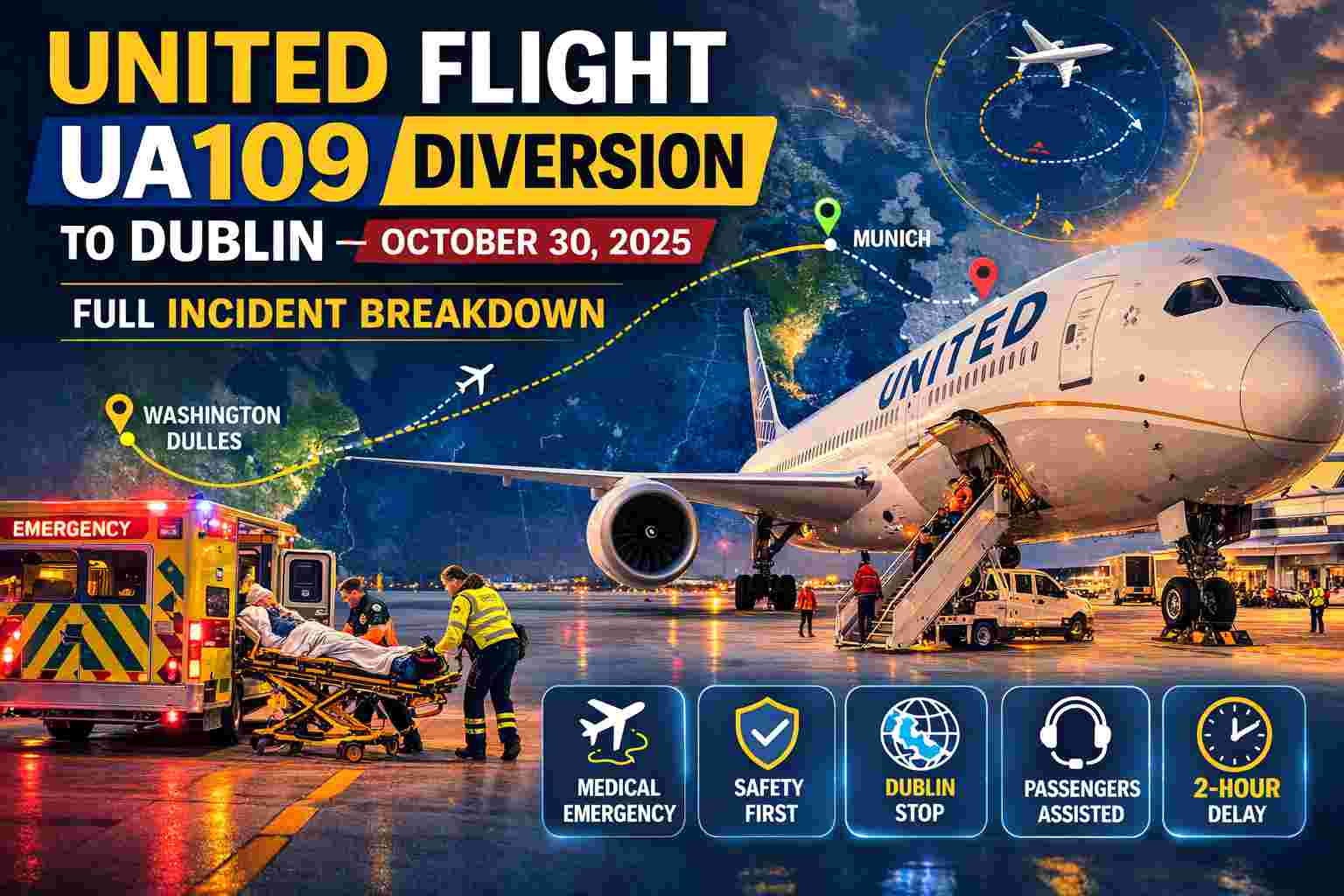
On October 30, 2025, United Flight UA109 made an unexpected stop in Dublin, Ireland, instead of continuing its scheduled route from Munich to Washington Dulles. The cause was not a mechanical failure or bad weather — it was a medical emergency involving a cabin crew member. The incident quickly drew attention from the global aviation community and mainstream media, raising questions about airline safety, crew protocols, and lessons learned from real-time in-flight emergencies. This article breaks down the full United flight UA109 diversion, including the timeline, the reason behind the decision, why Dublin was chosen, and what passengers experienced.
What Is United Flight UA109?
United Flight UA109 is a long-haul transatlantic service operated by United Airlines. It connects Munich Airport (MUC) in Germany with Washington Dulles International Airport (IAD) in the United States.
The route typically takes 8 to 9 hours and is served by a Boeing 787-8 Dreamliner — a modern aircraft known for fuel efficiency, passenger comfort, and extended overwater operations across oceanic corridors. Passengers on this route include business travelers, tourists, government employees, and connecting travelers between the U.S. East Coast and Europe.
The October 30, 2025, Diversion — Full Incident Breakdown
Timeline of Events
Here is a clear, minute-by-minute breakdown of what happened:
| Time | Event |
| 09:00 AM / 12:14 CET | UA109 departs Munich Airport (MUC) |
| ~10:30 AM CET | Medical emergency declared onboard |
| Mid-flight | Aircraft executes a U-turn over the North Atlantic at 40,000 feet |
| ~3:00 PM GMT | Boeing 787-8 (N28912) lands at Dublin Airport, runway 10L |
| 3:00 PM GMT | Emergency vehicles meet aircraft; crew member receives medical attention |
| ~4:15–4:20 PM GMT | UA109 departs Dublin for Washington |
| ~6:30 PM ET | Flight arrives at Washington Dulles — approximately two hours late |
The aircraft was roughly 600 nautical miles west of Ireland when the decision to divert was made. The turnaround was swift, and the landing at Dublin was precautionary — no in-air emergency was formally declared.
What Triggered the Diversion
The diversion was caused by a flight attendant who developed severe pain from a foot blister that worsened approximately 90 minutes into the flight, around 10:30 AM CET. While a blister may sound minor, the crew member’s mobility issues made it impossible to continue performing safety duties mid-flight.
Aviation regulations — enforced by both the FAA (Federal Aviation Administration) and EASA (European Union Aviation Safety Agency) — require airlines to maintain a minimum number of fit and active crew members on international routes at all times. When one crew member becomes incapacitated, the flight may no longer meet its legal requirements to continue, particularly over remote oceanic regions far from emergency support.
The captain made the decision to divert rather than risk a regulatory violation or leave passengers without adequate crew coverage for the remaining hours of the transatlantic flight.
Why Dublin Was the Chosen Diversion Airport
Dublin was not a random choice. It was the most practical and strategically optimal airport available for several reasons:
- ETOPS designation: Dublin Airport is a certified ETOPS (Extended-range Twin-engine Operations Performance Standards) alternate airport for transatlantic routes. It was already pre-planned as a valid emergency landing point for UA109’s specific flight path.
- Medical facilities: Dublin has on-site medical teams capable of handling crew and passenger emergencies with minimal delay.
- Runway capacity: The airport is fully equipped to receive wide-body aircraft like the Boeing 787-8 without special arrangements.
- Refueling capability: Ground crews could refuel and reset the aircraft quickly, allowing a swift turnaround and departure.
- Customs processing: Dublin’s efficient customs infrastructure allowed for a streamlined ground stop without requiring full passenger disembarkation or prolonged administrative delays.
- Location advantage: Other potential alternatives — such as Shannon or London Heathrow — were less favorable due to distance, logistics, and response time at that specific point in the route.
Dublin’s world-class infrastructure and its established reputation as a transatlantic diversion hub made it the ideal choice when UA109 required an unscheduled landing.
Early reports from flight trackers incorrectly suggested the flight was heading to Boston. This was a misread of tracking data. Dublin was always the confirmed diversion point.
Understanding ETOPS and Diversion Planning
ETOPS certification governs how twin-engine aircraft like the Boeing 787-8 are permitted to operate on routes that take them far from land — including long stretches over the Atlantic Ocean and remote oceanic regions.
Under ETOPS rules, airlines must pre-identify a set of certified alternate airports that any aircraft on a given route can safely reach within a defined time window if an emergency occurs. These airports must meet specific standards for runway capacity, medical infrastructure, and ground support.
For the Munich–Washington route, Dublin was one of those pre-approved alternates. This preplanning is what allowed the flight crew and the airline’s operations control center to make a rapid decision through real-time consultations when the emergency arose — without needing to calculate options from scratch mid-flight.
Fuel levels and weather conditions at potential alternates are also factored into ETOPS planning before every departure, ensuring that diversion decisions can be executed within minutes when needed.
ETOPS is also why the diversion happened smoothly. The system is designed for exactly this scenario.
How Diversion Decisions Are Made in Long-Haul Aviation
When a medical issue occurs on a long-haul flight, the captain has the final authority but does not act alone. The decision process typically involves:
- Assessing whether the remaining crew can still fulfill all safety roles, including emergency evacuation procedures and passenger assistance
- Consulting with the airline’s operations control center in real time
- Evaluating fuel levels, weather conditions at nearby airports, and diversion time
- Checking ETOPS guidelines for certified alternate airports on the current route
- Confirming medical support availability at the diversion airport
In the case of UA109, all these factors pointed to Dublin. The crew did not have the option to continue legally without meeting minimum crew staffing requirements. Proceeding would have constituted a regulatory violation under both FAA and EASA rules, jeopardizing both safety margins and crew fitness standards across the remainder of the flight.
Aircraft Details — Boeing 787-8 Dreamliner
The aircraft operating UA109 was a Boeing 787-8 Dreamliner, registered as N28912.
| Feature | Detail |
| Aircraft Type | Boeing 787-8 Dreamliner |
| Registration | N28912 |
| Passenger Capacity | ~240 (Economy + Business Class) |
| Cabin Altitude Pressure | Lower than most aircraft — reduces passenger fatigue |
| Air Quality | Improved filtration and humidity levels for long-haul comfort |
| Range | Ultra long-haul capable |
| Key Features | Larger windows, advanced avionics, and extended range |
The Dreamliner’s extended range and fuel efficiency make it well-suited for transatlantic operations. The aircraft itself had no mechanical issues — it continued operating normally after the Dublin stop and completed the journey to Washington Dulles without further incident.
Landing and Medical Assistance in Dublin
UA109 landed safely at Dublin Airport at approximately 3:00 PM GMT and was met by emergency vehicles on runway 10L. A medical team was standing by to assess the crew member immediately upon arrival.
The crew member was treated on-site and did not require hospitalization. Once cleared by medical staff, they were deemed stable and fit to continue. United Airlines did not disclose further health details, consistent with standard medical privacy standards.
Passengers were not required to disembark the aircraft during the stop. The plane remained on the tarmac while refueling took place and systems were reset for the continuation of the flight. Refreshments were provided, and cabin crew kept everyone informed throughout the ground stop.
Impact on Passengers — What They Experienced
The UA109 diversion was handled with transparency. The flight crew made clear cockpit announcements explaining the reason for the change in route, which helped prevent unnecessary concern among those onboard.
During the Dublin stop, passengers:
- Remained onboard at the diversion airport throughout the ground stop
- Were kept updated on timelines and the next steps
- Received refreshments during the wait
- Were advised on the status of their checked bags, which remained onboard throughout
- Were offered meal vouchers or hotel vouchers, where applicable, for those facing extended delays or missed connections
United Airlines activated delay management procedures promptly. Passengers with tight connections were given rebooking support, and the airline honored its standard duty-of-care obligations around passenger well-being. No cancellations were issued — the flight continued to Washington Dulles with a delay of approximately two hours and a safe landing.
Medical Emergencies and Crew Health in Aviation
Crew medical emergencies are one of the most common causes of unscheduled landings — and one of the least publicly discussed. An incapacitated crew member is treated with the same level of urgency as a technical problem or adverse weather event, because the legal and safety implications are nearly identical.
Other notable United Airlines diversions involving similar situations include:
- UA507 — Diverted to Iceland due to a windshield crack
- UA939 — Diverted to London due to engine vibrations
These examples reinforce that diversions are not rare events. They happen daily across the global aviation network. What matters is how quickly and correctly they are handled — and the UA109 diversion is widely regarded as a textbook response built on professionalism and a clear commitment to crew health and human health above all else.
How Common Are Flight Diversions?
Flight diversions occur every day across the world. Most go unreported because they are resolved quickly and without injury. As aviation insiders know, these events are a routine and expected part of managing air travel safely. Common causes include:
| Cause | Examples |
| Medical emergency (crew or passenger) | UA109 diversion, multiple daily incidents globally |
| Mechanical anomalies | Windshield cracks, engine vibrations |
| Passenger misconduct/disturbances | Domestic US diversions |
| Weather issues | Storms, wind shear, icing |
United Airlines alone handled multiple diversions during the same period, including a Denver-to-Los Angeles flight rerouted to Salt Lake City due to windshield damage. The UA109 event was treated as an isolated medical occurrence — not indicative of any systemic issue with the airline or the route. These incidents collectively demonstrate that diversion protocols are active, routine, and functioning as designed.
Clarifying Confusion — Was Boston the Destination?
Several early social media posts and flight tracking screenshots incorrectly identified Boston as the destination for UA109 on October 30, 2025. Some sources also confused flight numbers, adding to the spread of misinformation online.
The facts are clear: United Flight UA109’s official route on that date was Munich (MUC) to Washington Dulles (IAD). The diversion airport was Dublin (DUB). Verified sources — including United Airlines, flight-tracking logs, and aviation news outlets — consistently confirm these details.
The confusion likely arose from a Delta flight (DL257 to Boston) that also diverted to Dublin on the same day, around the same time. The two incidents happening simultaneously caused some tracking data to be misattributed across platforms.
Post-Diversion Status — Is UA109 Back to Normal?
As of early January 2026, United Flight UA109 continues to operate on its standard Munich-to-Washington Dulles route with no schedule changes linked to the October 2025 diversion. The aircraft involved (N28912) remains in regular service.
The event was treated as an isolated medical occurrence with no lasting operational impact. United Airlines’ airline recovery systems handled the situation efficiently, and the carrier made no route adjustments, frequency changes, or fleet swaps as a result of this incident. Scheduling returned to normal within hours of the flight resuming.
United Airlines’ Crisis Handling and Communication
United Airlines managed the UA109 diversion efficiently across all fronts:
- Crew response: Immediate assessment and diversion decision within minutes of the medical issue arising
- Ground coordination: The medical team arranged in advance of landing in Dublin
- Passenger communication: Clear, timely cockpit announcements throughout the event
- Official statement: Confirmed the nature of the diversion without unnecessary alarm
- Delay management: Rebooking and passenger support are activated for connecting travelers
Aviation journalists, aviation blogs, and flight tracker communities noted the professionalism of the response. Coverage across mainstream news and social media was largely factual and measured. The airline’s transparency and speed were widely cited as best practices in airline crisis handling and communication.
What This Incident Reveals About Aviation Safety
The UA109 diversion is a clear example of a system working exactly as intended. One crew member’s medical condition triggered an international reroute — not because the flight was in danger, but because safety margins and legal crew fitness standards leave no room for compromise.
Key takeaways from this incident:
- Human health is treated with the same weight as mechanical airworthiness and potential mechanical malfunctions
- Real-time decision-making between crew and operations centers is fast and highly structured
- ETOPS preplanning removes guesswork from emergency diversion choices entirely
- International coordination between airlines, airports, and medical teams is seamless when protocols are followed correctly.
Flying remains one of the safest modes of transportation in the world precisely because these systems exist and are rigorously enforced on every flight.
Conclusion
The United Flight UA109 diversion on October 30, 2025, was handled with speed, professionalism, and full regulatory compliance. What began as a crew member’s medical issue over the North Atlantic ended safely in Dublin — with passengers resuming their journey the same day, only two hours behind schedule.
The incident is a reminder that modern aviation is built on layers of preparedness. From ETOPS preplanning to FAA and EASA crew requirements, every protocol exists for a reason. The successful resolution of the UA109 diversion is a textbook example of efficiency, safety protocols, and passenger well-being being prioritized above all else — and clear proof that the system works.
FAQs
FAQ 1: Why did United Flight UA109 divert to Dublin on October 30, 2025?
UA109 diverted because a cabin crew member developed severe blistering on her foot that prevented her from performing safety duties. Aviation regulations require a minimum number of medically fit crew members on international routes at all times. When that threshold was no longer met, the captain initiated a precautionary diversion to Dublin.
FAQ 2: Was the aircraft damaged or unsafe during the diversion?
No. The Boeing 787-8 Dreamliner (N28912) had no technical malfunction, structural damage, or equipment failure of any kind. The diversion was entirely due to crew health — not any issue with the aircraft itself. The plane resumed normal operations after a short stop in Dublin.
FAQ 3: What was the original route of United Flight UA109?
UA109 was scheduled to fly nonstop from Munich Airport (MUC) in Germany to Washington Dulles International Airport (IAD) in the United States — a long-haul transatlantic route typically operated by a Boeing 787-8 Dreamliner.
FAQ 4: Why is Dublin a common airport for transatlantic diversions?
Dublin is a certified ETOPS alternate airport, meaning it meets all requirements for receiving wide-body aircraft during emergencies on transatlantic routes. It offers emergency medical care, adequate runway capacity, fast refueling, and a strategic location along major North Atlantic flight paths.
FAQ 5: Did passengers continue their journey the same day?
Yes. After the crew member received medical care in Dublin, UA109 resumed its flight to Washington Dulles. Passengers arrived approximately two hours late with no cancellations. Those with tight connections received rebooking assistance from United Airlines.
FAQ 6: Is United Flight UA109 still operating its regular route?
Yes. As of early 2026, UA109 continues operating normally on the Munich-to-Washington Dulles route. No schedule changes were made following the October 2025 diversion, and the incident had no lasting impact on the flight’s normal operations.
